
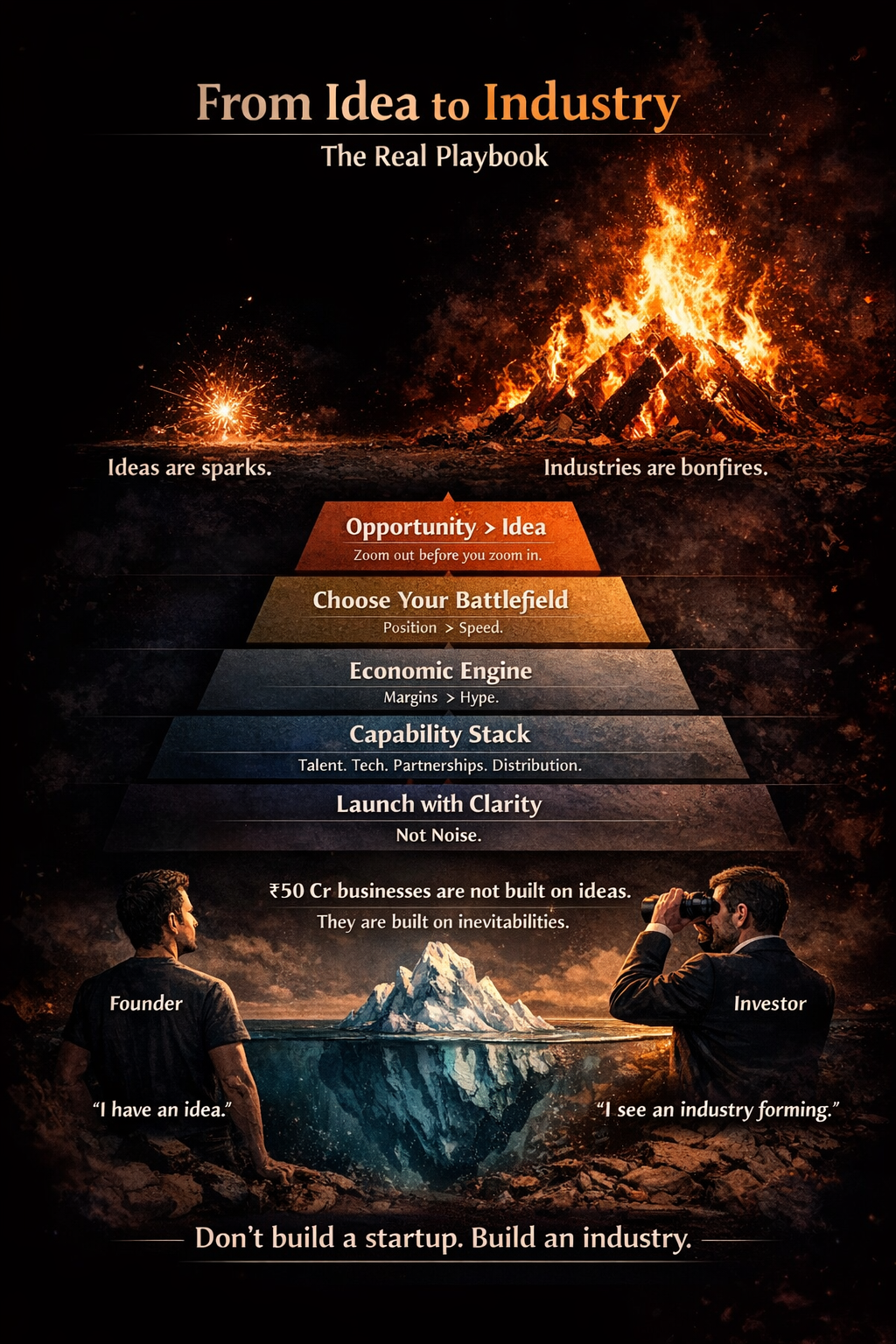
Building a real business with Rs.15 to Rs.100 crore of capital is not startup theatre. It is strategy.
Because serious ventures are not built from ideas.
They are built from industries waiting to happen.
Ideas are sparks.
Industries are bonfires.
The journey from idea to industry follows a very different playbook..
Most founders start with a product idea. Smart entrepreneurs start with opportunity analysis.
They ask three uncomfortable questions:
– Is the problem big enough?
– Is the market expanding?
– Is there a gap others have ignored?
Take semiconductors.
Everyone talks about building fabs. But a single fabrication plant costs billions. Yet India’s semiconductor ecosystem offers many entry points. Chip design, testing, packaging, specialised materials, embedded systems.
The opportunity is not always the factory.
Sometimes it is the layer around the factory.
2.Choosing the Battlefield
Once opportunity is visible, the next step is strategic positioning.
In business, where you stand often matters more than how fast you run.
Consider a personal care brand.
Instead of launching another generic skincare line, a venture could position itself around dermatology backed formulations or Ayurveda with clinical validation.
3.Designing the Economic Engine
A ?50 crore venture cannot run on enthusiasm alone.
It needs an economic engine.
Take niche services.
Instead of building a generic IT services firm, imagine focusing on AI compliance consulting or deep tech product engineering for US startups. A few clients. Large contracts. Strong margins.
Scale does not always come from volume.
Sometimes it comes from precision.
4.Building the Capability Stack
Once the strategy is clear, the company builds its capability stack.
Talent.
Technology.
Partnerships.
Distribution.
A semiconductor design venture partners with global fabs.
A personal care brand outsources manufacturing but owns the brand.
A niche services firm builds domain depth and global relationships.
5.Launch With Clarity, Not Noise
When the venture finally launches, success rarely comes from hype.
It comes from clarity and credibility.
Customers must instantly understand:
What problem you solve.
Why you are different.
Why they should trust you.
Ideas are common.
Opportunities are rare.
Industries are built by those who see the difference.
So perhaps the real question for aspiring entrepreneurs is this:
Are you launching a startup because you have an idea… or
are you building a company because you see the shape of an industry that others haven’t noticed yet?