
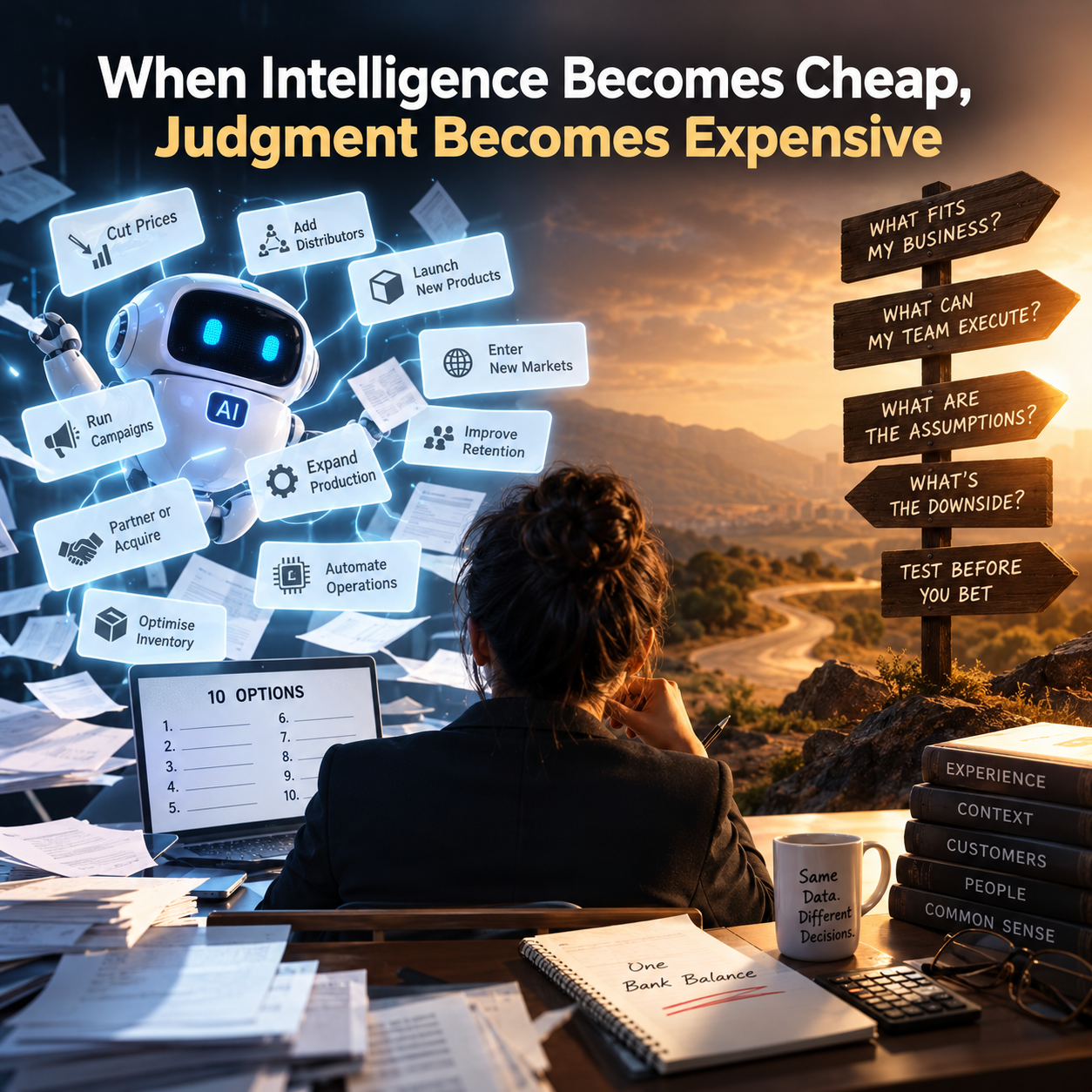
The most expensive mistake in your business could begin with a free answer. For years, access to data, knowledge and analytical expertise commanded a premium. Few had the information. Fewer could interpret it. Most promoters paid for both. Now AI puts much of that capability within reach, often for free.
So when everyone can access intelligence, what deserves a premium?
The judgment to decide what to do with it.
Ask AI how to revive slowing sales. It can analyse the inputs and suggest ten plausible routes: cut prices, add distributors, launch products, enter markets, improve retention…
Ten options. One bank balance.
You can try them all. Your cash flow may prefer a less adventurous promoter.
The real work is choosing what fits YOUR business, YOUR team and THIS moment.
And recognising when a convincing answer rests on a wrong assumption.
Consider a manufacturer with falling sales. More distributors may look logical. But if existing dealers are sitting on unsold stock, expanding distribution could simply distribute the problem.
Experience helps you ask what the spreadsheet missed.
Theory explains how credit drives sales.
Experience remembers the customer who bought enthusiastically and paid philosophically.
But experience needs updating too. “We tried this in 2016” is context, not a permanent ban.
For promoters, better judgment can become a practical discipline:
Define the decision before requesting solutions.
“Grow sales” is vague.
“Improve cash generation without adding fixed costs” gives the analysis a useful boundary.
Make every option earn its place.
Compare cash required, time to results, team capability and downside.
A brilliant strategy that your team cannot execute is expensive literature.
Ask what would make the recommendation wrong.
Check its assumptions with customers, dealers and people doing the work.
Ask AI for the strongest case against its own answer.
Test before you bet.
Try one territory, one customer segment or one production line.
Set a budget, a success measure and a stopping point before enthusiasm takes charge.
Put fresh eyes beside experienced eyes.
Let younger colleagues challenge conventions.
Let seasoned colleagues probe consequences.
Neither youth nor grey hair grants immunity from bias.
We need analytical rigour alongside creative imagination: the ability to read the numbers and imagine an option the numbers haven’t captured yet.
Fresh energy asks, “Why not?”
Earned wisdom asks, “What are we missing?”
A good promoter makes room for both.
AI can make recommendations cheaper. You still carry the cost of choosing.
Are you using AI to challenge your judgment, or merely decorate your existing opinion?
And when ten answers look convincing, do you have a method for choosing one or just a favourite?