
For years, the tech world believed that the ultimate competitive advantage in software was simple: write better code.
Then AI arrived.
And for the past few years, the buzzword dominating every conversation has been Prompt Engineering. Entire courses, frameworks, and tutorials emerged teaching people how to write better prompts for tools like ChatGPT.
But something interesting is happening now.
The conversation is quietly shifting from Prompt Engineering to Context Engineering.
Because prompts alone are not enough anymore.
Prompt engineering is like giving a smart assistant a single instruction.
But AI agents don’t operate on single instructions. They operate inside an environment of information, memory, tools, and constraints.
And that environment is what we call context.
In the coming years, the real advantage in AI will not come from writing clever prompts.
It will come from engineering the right context in which AI agents operate.
Think of it this way.
Imagine hiring a brilliant executive and giving them only one instruction at a time with no background, no history, and no access to information. Their performance will always be limited.
Now imagine placing that same executive inside an organisation where they have access to past decisions, internal knowledge, data dashboards, tools, and clear goals.
Suddenly the same person becomes dramatically more effective.
AI agents work exactly the same way.
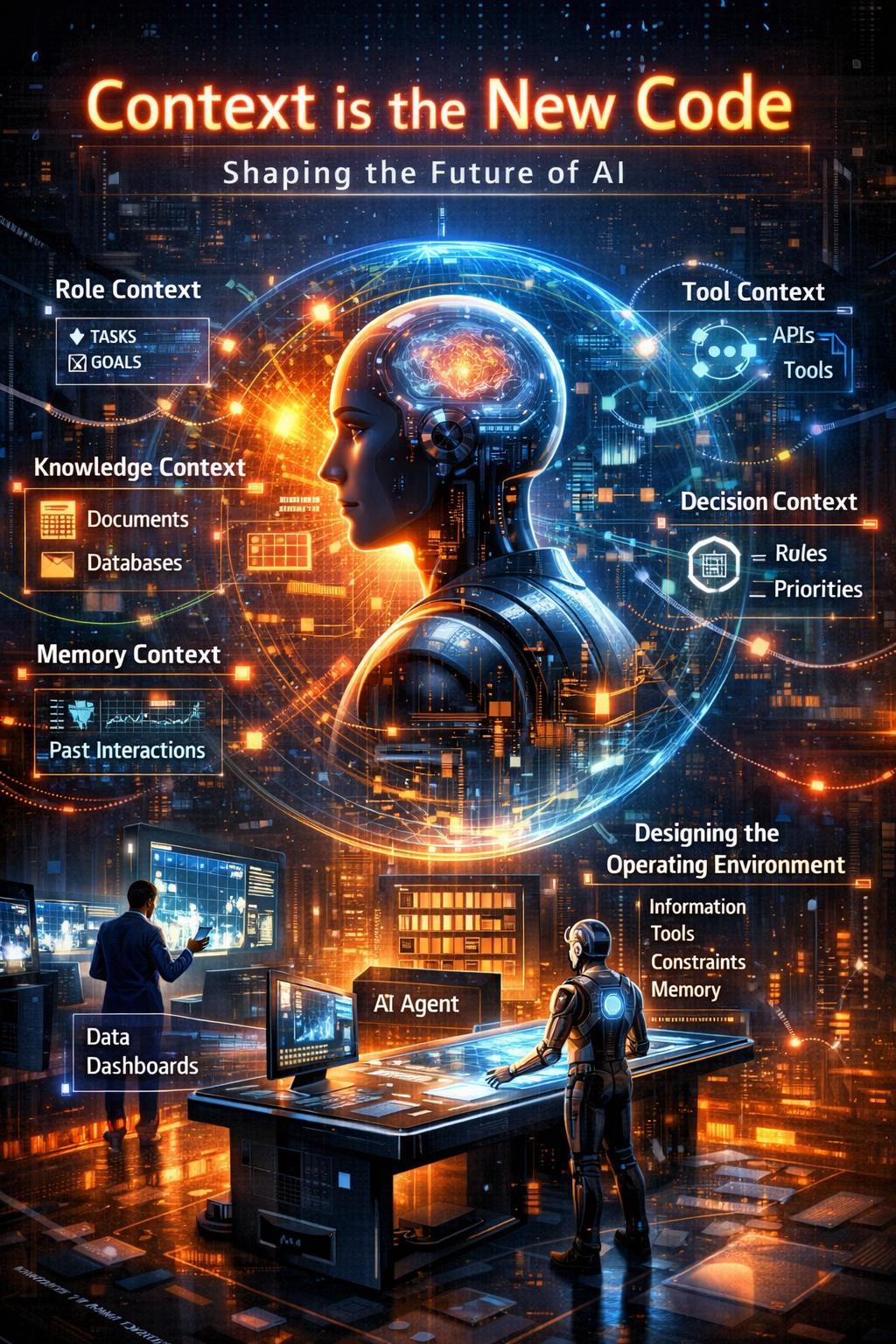
Context engineering means designing the operating environment of intelligence.
It includes:
1) Role Context:
What exactly the AI agent is supposed to do.
2) Knowledge Context:
Documents, databases, and knowledge sources the agent can access.
3) Memory Context:
Past interactions and learning that help the agent improve over time.
4) Tool Context:
What systems, APIs, or workflows the agent can trigger.
5) Decision Context:
The rules, priorities, and boundaries that guide its actions.
Without context, even the most powerful AI models behave like confused interns.
With the right context, they start behaving like capable digital teammates.
That is why the AI race will not just be about bigger models or better prompts.
It will be about better context design.
As AI researcher Andrej Karpathy famously said,
“The hottest new programming language is English.”
But perhaps the next evolution of that idea is this:
The real programming language of AI agents is context.
Because prompts tell the AI what to say.
Context tells the AI how to think, what to remember, and what actions to take.
And in the world of AI agents, that makes all the difference.
The future will not belong to those who simply talk to AI well.
It will belong to those who design the world in which AI thinks.