
Forget the IPO. Forget the valuation. Forget the rockets. After reading SpaceX’s Roadshow Presentation and its 400-page Prospectus, I walked away with a strange thought.
I wasn’t reading an investment document.
I was reading science fiction with legal disclaimers.
Most IPO prospectuses begin with revenue, margins and market size.
SpaceX begins with humanity.
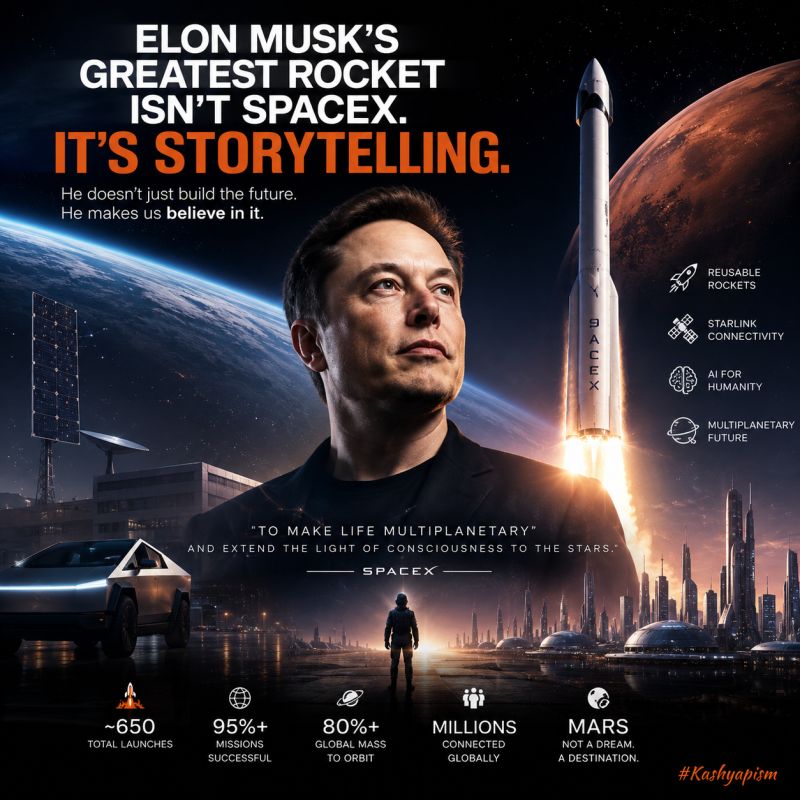
It talks about making life multiplanetary. About extending the light of consciousness to the stars. It sounds less like Wall Street and more like Christopher Nolan directing an investor presentation.
And that’s precisely the point.
Every founder tells investors where the company is going.
Elon Musk tells them where humanity is going, and quietly invites SpaceX to become the vehicle.
That’s a completely different pitch.
Imagine any first-time founder presenting this deck.
“Colonise Mars.”
“Build orbital AI.”
“Transform civilisation.”
Most investors would politely smile before showing them the door.
With Elon Musk, however, the room leans forward.
Why?
Because stories are judged not just by imagination, but by the storyteller.
Before SpaceX, there was PayPal.
Then Tesla.
Then reusable rockets that “could never work.”
Then Starlink.
Along the way came spectacular explosions, near bankruptcies, impossible deadlines, public ridicule and countless predictions of failure.
Every failure became another chapter.
Every comeback increased his narrative equity.
Eventually, investors stopped asking, “Can this be done?”
Instead they began asking, “What if he does it again?”
That single shift changes valuation more than any spreadsheet ever can.
Perhaps Musk has discovered the ultimate entrepreneurial equation.
Execution builds credibility.
Credibility earns belief.
Belief finances impossible dreams.
Impossible dreams become reality.
Then the cycle repeats.
Maybe that’s why SpaceX’s IPO barely feels like an IPO.
It feels like a movie trailer for the future.
And maybe Elon Musk’s greatest invention isn’t a rocket, a car or a satellite.
Maybe it is the ability to make millions of intelligent people suspend disbelief, long enough for fiction to become engineering.
Which leaves me with three uncomfortable questions:
Is Elon Musk the greatest innovator of our time?
Or the greatest storyteller?
Or have we been asking the wrong question all along?
Because perhaps every world-changing innovation begins as unbelievable storytelling.
The only difference is that, every once in a generation, someone lives long enough to prove the story was true.