
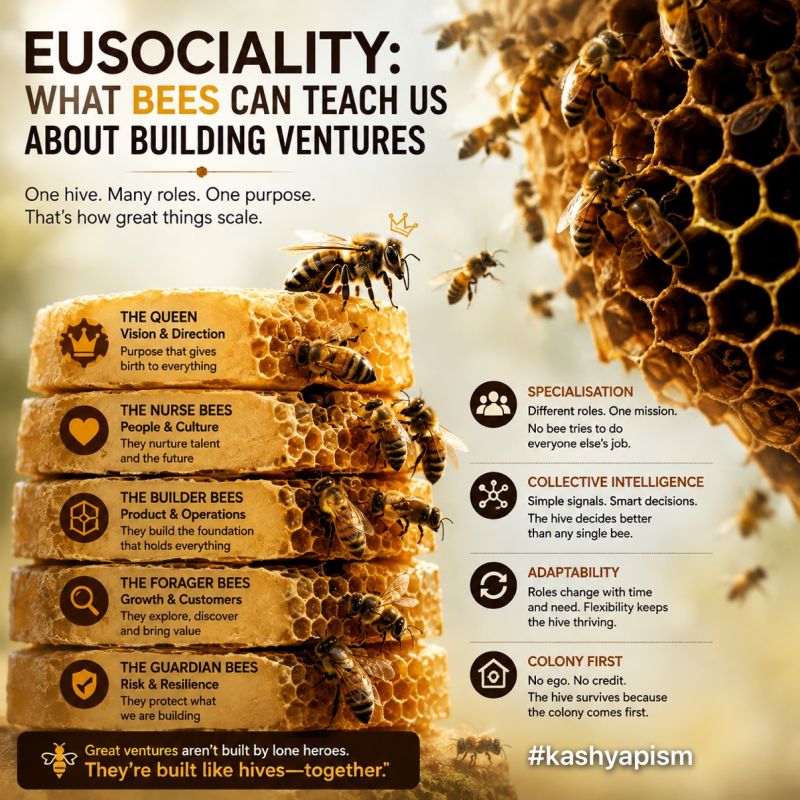
A beehive may be one of nature’s oldest startups. Except it figured out scaling, specialisation and succession millions of years before founders discovered pitch decks.
The science behind it is called #eusociality.
Seen most famously among bees, ants and termites, eusocial species live in highly organised colonies characterised by cooperation, overlapping generations and division of reproductive labour.
But bees make the idea particularly fascinating.
A hive can contain tens of thousands of bees, performing different roles: workers forage, nurse bees care for the young, others build and maintain the hive, guard bees protect it, while the queen performs a specialised reproductive role.
Different jobs. One hive.
No quarterly offsite required to explain the mission.
There is an interesting lesson here for anyone building a venture.
In the beginning, founders behave like the entire beehive.
Product. Sales. Hiring. Fundraising. Customer complaints. Strategy.
Necessary initially.
Dangerous eventually.
Because what gets you buzzing may not get you scaling.
A successful hive works through specialisation.
Different bees perform different tasks, and roles can shift with age and colony needs.
Eusociality offers another powerful lesson: collective intelligence.
When honeybees search for a new nest, scout bees explore different locations and communicate their discoveries through signals such as the famous waggle dance.
Through interaction and accumulating support, the colony can converge on a choice.
No bee knows everything.
Yet collectively, the hive can make remarkably sophisticated decisions.
Perhaps organisations should work similarly.
The founder doesn’t need every answer.
The organisation needs the ability to find better answers.
Information must travel.
Feedback must matter.
Decisions should happen close enough to where the knowledge resides.
Less control. More coordination.
Less hierarchy. More hive.
And perhaps there is an even bigger entrepreneurial lesson.
A bee doesn’t build honeycomb for personal applause.
The architecture serves the colony.
Founders eventually face the same transition:
from my idea, my company, my way to
our purpose, our people, our venture.
Otherwise, you haven’t built an organisation.
You have simply created a very demanding job and hired people to watch you do it.
The real test of venture building, therefore, may not be how indispensable the founder becomes.
It may be exactly the opposite.
Can you build a hive that continues to buzz without you buzzing into every decision?
Because great founders don’t merely build ventures.
They build systems, specialists and shared intelligence that make the venture bigger than the founder who started it.
And perhaps that is nature’s little MBA:
Don’t just be the busiest bee.
Build the better hive.