
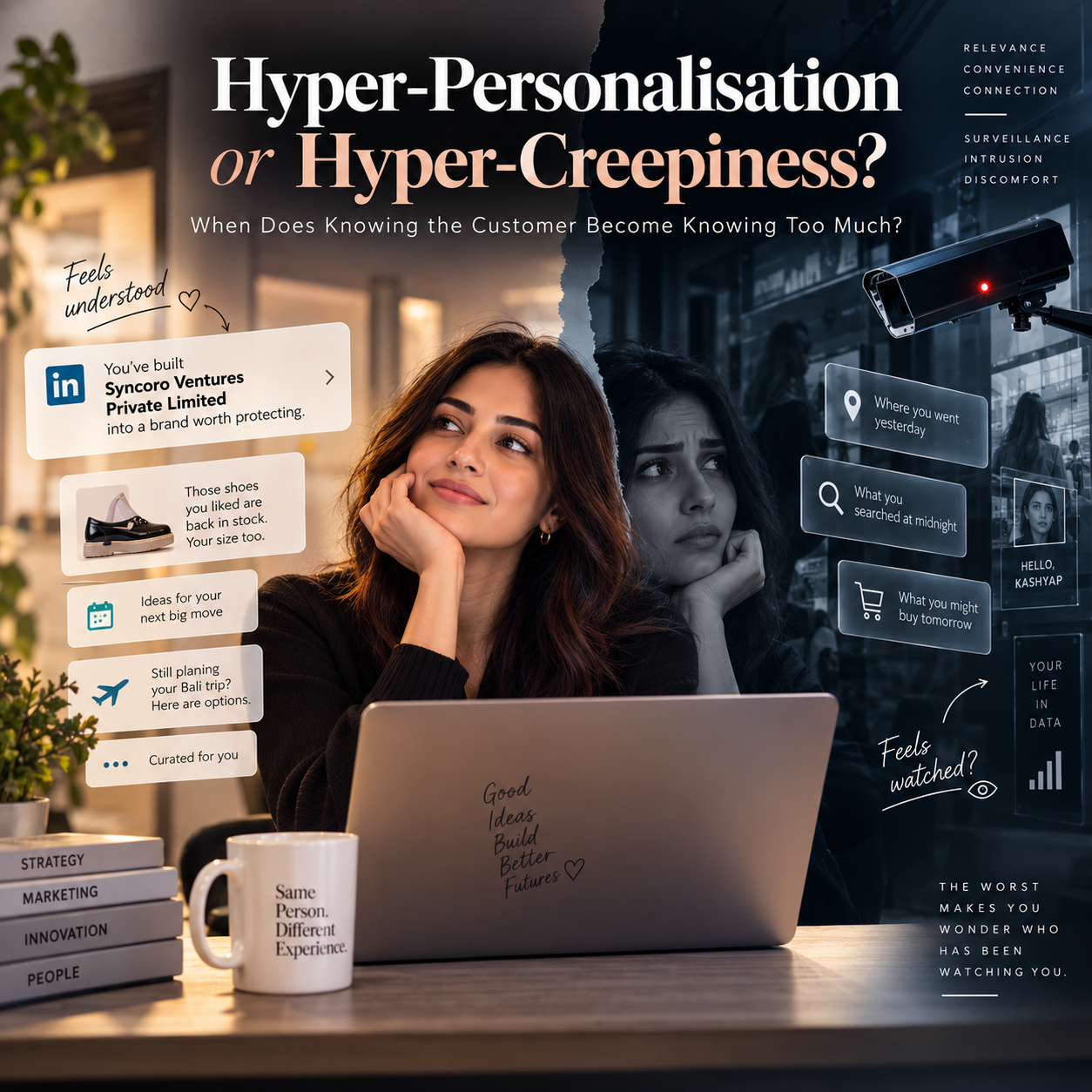
The best marketing makes you feel understood. The worst makes you wonder who has been watching you.
Yesterday, while scrolling through LinkedIn, I saw an advertisement that said:
“You’ve built Syncoro Ventures Private Limited into a brand worth protecting.”
I stopped scrolling.
Not because I suddenly developed an irresistible urge to register a trademark, but because the advertisement knew the name of my company.
Welcome to the age of hyper-personalisation, where “Dear Customer” has evolved into “Dear Kashyap, congratulations on what your company did last week.”
And this is only the beginning.
For marketers, personalisation makes perfect sense.
Advertising has always suffered from one fundamental problem: relevance.
The more a brand understands your context, behaviour, preferences, location, profession and intent, the less advertising feels like advertising.
It starts feeling like a conversation.
AI is taking this several steps further.
An email can now begin with news about your company, refer to your recent LinkedIn post, identify a possible business problem and offer a solution specifically written for you.
One campaign.
Ten thousand recipients.
Ten thousand different conversations.
For marketers, that is not incremental improvement. It is a superpower.
But every superpower eventually needs a superhero code.
Because there is a thin line between:
“They understand me.”
and
“How on earth do they know that?”
Personalisation creates relevance.
Excessive personalisation creates surveillance anxiety.
A brand may know my company, designation and professional interests. Fine.
But should it know where I went yesterday, what I searched at midnight and perhaps what I am likely to buy tomorrow?
Technology will increasingly make all this possible.
Imagine walking past a store a few years from now.
The glass facade is no longer just glass. It is a camera, screen and AI interface. It recognises you, understands your profile and instantly changes the display.
“Good evening, Kashyap. Those shoes you checked online are available inside. Your size too.”
Brilliant marketing?
Or Black Mirror with a loyalty programme?
That will become one of the biggest questions facing marketers.
The future of advertising may not be about reaching a million people with one great advertisement. It may be about creating a million advertisements for a million individuals, in real time.
Exciting times for marketers and advertising professionals? Absolutely.
But personalisation should make a customer feel recognised, not recognised by facial recognition.
The future belongs to brands that know us better.
And have the wisdom to occasionally pretend they don’t.