
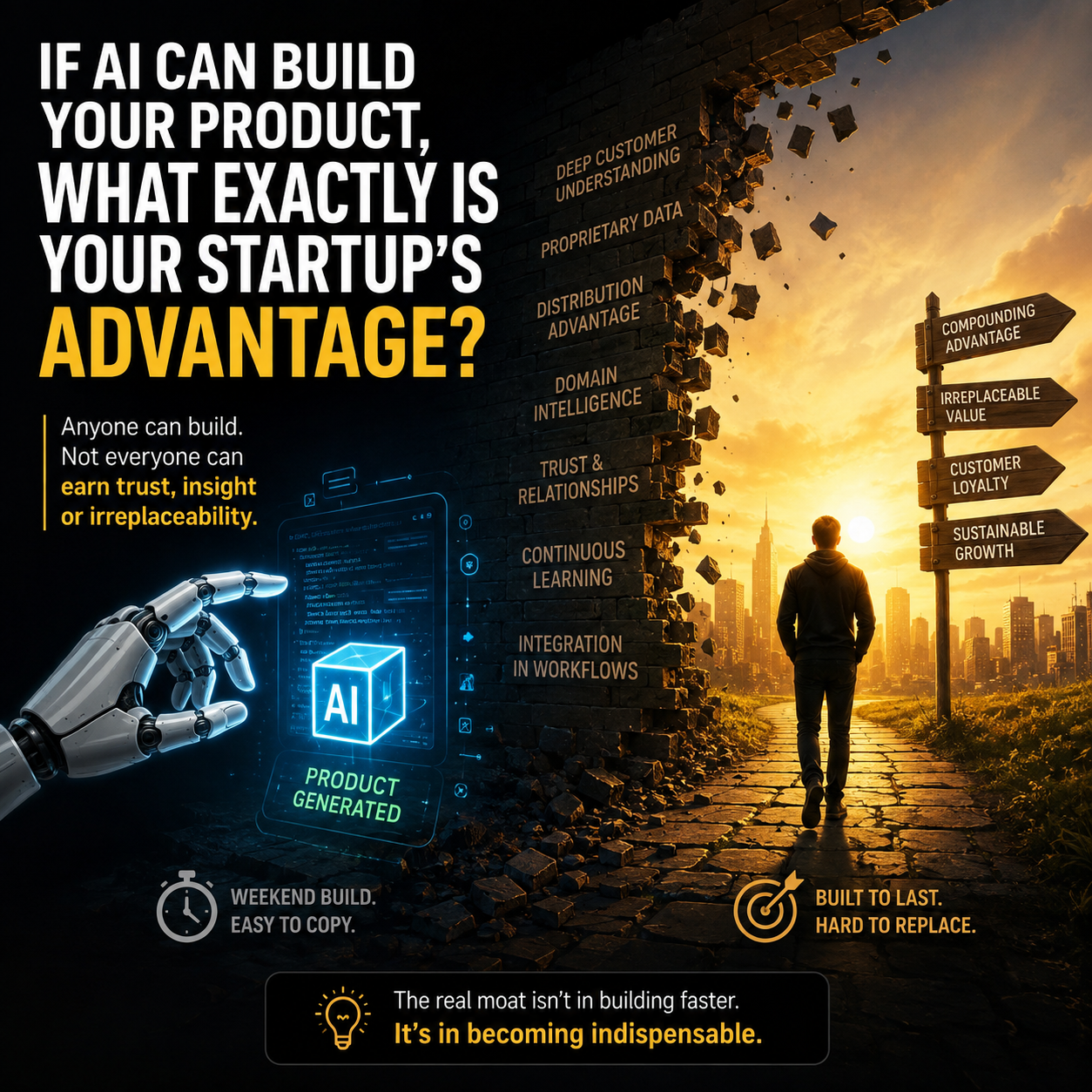
Your startup may have taken two years to build. AI may help someone replicate it over a weekend. Uncomfortable? It should be.
For years, technology itself was considered a moat. If you could assemble the right engineers, write complex code and launch a working product, you had a significant head start.
That head start is rapidly becoming a head illusion.
AI can now write code, design interfaces, create content, analyse data and automate workflows. The cost of creating a product is falling. So is the time required.
When the barrier to building collapses, “we have a great product” stops sounding like an advantage and starts sounding like an entry requirement.
This does not mean technology has become irrelevant. It means technology alone is no longer enough.
The real question is not whether someone can copy your product. They probably can. The question is whether they can copy everything around it.
Can they replicate your understanding of the customer, earned through hundreds of conversations rather than downloaded through three prompts?
Can they recreate your distribution, trusted relationships, proprietary data, domain intelligence and the speed at which your team learns?
Can they copy the trust customers place in you when something goes wrong?
A feature can be duplicated.
A deeply embedded workflow is harder to displace.
An interface can be recreated.
Years of contextual data cannot be manufactured overnight.
A competitor may copy what the customer sees, but not what makes the customer stay.
This is where many AI startups may get exposed. They are building impressive wrappers around models owned by someone else and calling the wrapping paper intellectual property.
If the underlying model adds the same capability tomorrow, the startup’s differentiation may disappear before its next pitch-deck update.
In the AI era, the moat may not lie in building faster. It may lie in learning faster, reaching customers more efficiently and converting usage into intelligence that continuously improves the offering.
The strongest startups will combine technology with an advantage that compounds: proprietary data, specialised domain knowledge, network effects, distribution access, customer trust or deep integration into critical processes.
AI is democratising creation. Wonderful for innovation, but inconvenient for anyone whose entire advantage was the difficulty of creation.
So perhaps founders need to stop asking, “What can we build with AI?”
A better question is, “What can we build that becomes more difficult to replace every time a customer uses it?”
If your product can be rebuilt in days, why will the customer choose you?
If your technology belongs to someone else, what truly belongs to your startup?
And when everyone can build, what exactly have you built that can endure?