
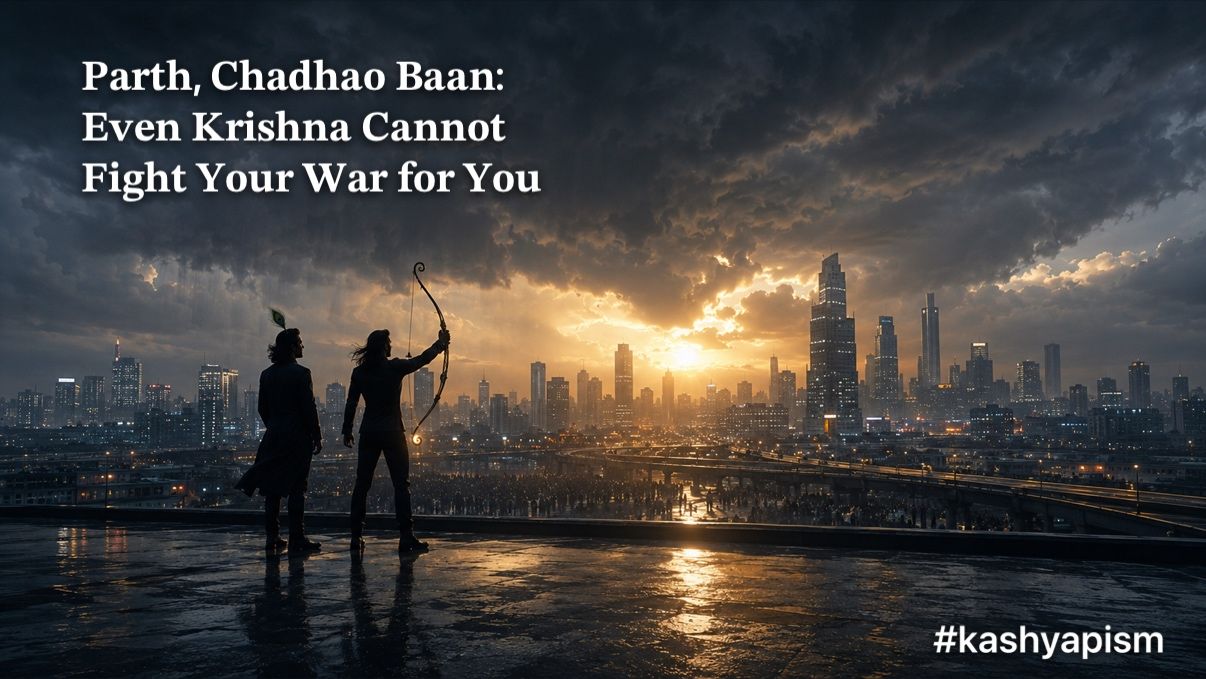
Krishna could have ended the Mahabharata war before sunset with one turn of the Sudarshan Chakra. Yet, when Arjuna lowered his Gandiva, Krishna did not pick it up.
He did not say, “You look emotionally exhausted. Let me handle this.”
He said, in essence, “Parth, chadhao baan.”
Arjuna was not facing strangers. Across the battlefield stood Bhishma, Dronacharya and others he revered, making the enemy painfully familiar.
His confusion was understandable.
But his surrender would not have been acceptable.
Because the war was not merely against people.
It was against injustice, humiliation, manipulation and a system that had repeatedly chosen convenience over dharma.
Krishna could give Arjuna perspective.
He could expose his excuses, challenge his attachment, remind him of his strength and stand beside him through the battle.
But Krishna could not become Arjuna.
Perhaps that is the real meaning of having a Sakha.
A true Sakha does not make you permanently dependent on his strength.
He awakens yours.
He does not rescue you from every battlefield.
He reminds you why you are capable of winning it.
Had Arjuna still refused to fight after receiving Krishna’s wisdom, Krishna would not have stopped being his Sakha.
But Arjuna would have failed to honour that friendship.
A Sakha can guide you, strengthen you and stand beside you, but if you repeatedly refuse to act, even his presence becomes powerless.
Krishna’s role was to awaken Arjuna; Arjuna’s responsibility was to rise.
We all reach our own Kurukshetra.
We know what must end, but remain attached to what once was.
We know which relationships weaken us, but keep protecting them because they carry familiar names.
We know the path ahead, but wait for someone else to walk it for us.
Sometimes, choosing dharma means disappointing people we love.
Sometimes, it means stepping away from those who prefer our weaker version because it is more convenient for them.
It does not mean hating or harming them.
It means refusing to sacrifice your future merely to preserve your past.
Krishna did not ask Arjuna to fight only to protect dharma.
He asked him to reclaim the warrior buried beneath guilt, fear and attachment.
The battle did not create Arjuna’s strength. It revealed it.
And when Arjuna finally lifted the Gandiva, he was no longer fighting because Krishna had instructed him. He was fighting because he had rediscovered who he was.
Perhaps Krishna enters our lives for the same reason. Not to carry us forever, but to stand beside us until we can stand for ourselves.
This Janmashtami, ask yourself:
Have you found your Krishna but still refused to become Arjuna?
Which attachment makes you repeatedly lower your bow?
And how long will you keep asking Krishna for a miracle when he is waiting for you to gather the courage and say:
“My Gandiva is ready.”