
Sometimes, the biggest advantage a startup founder has is not knowing how difficult the journey is going to be!
Sounds ridiculous? Look around.
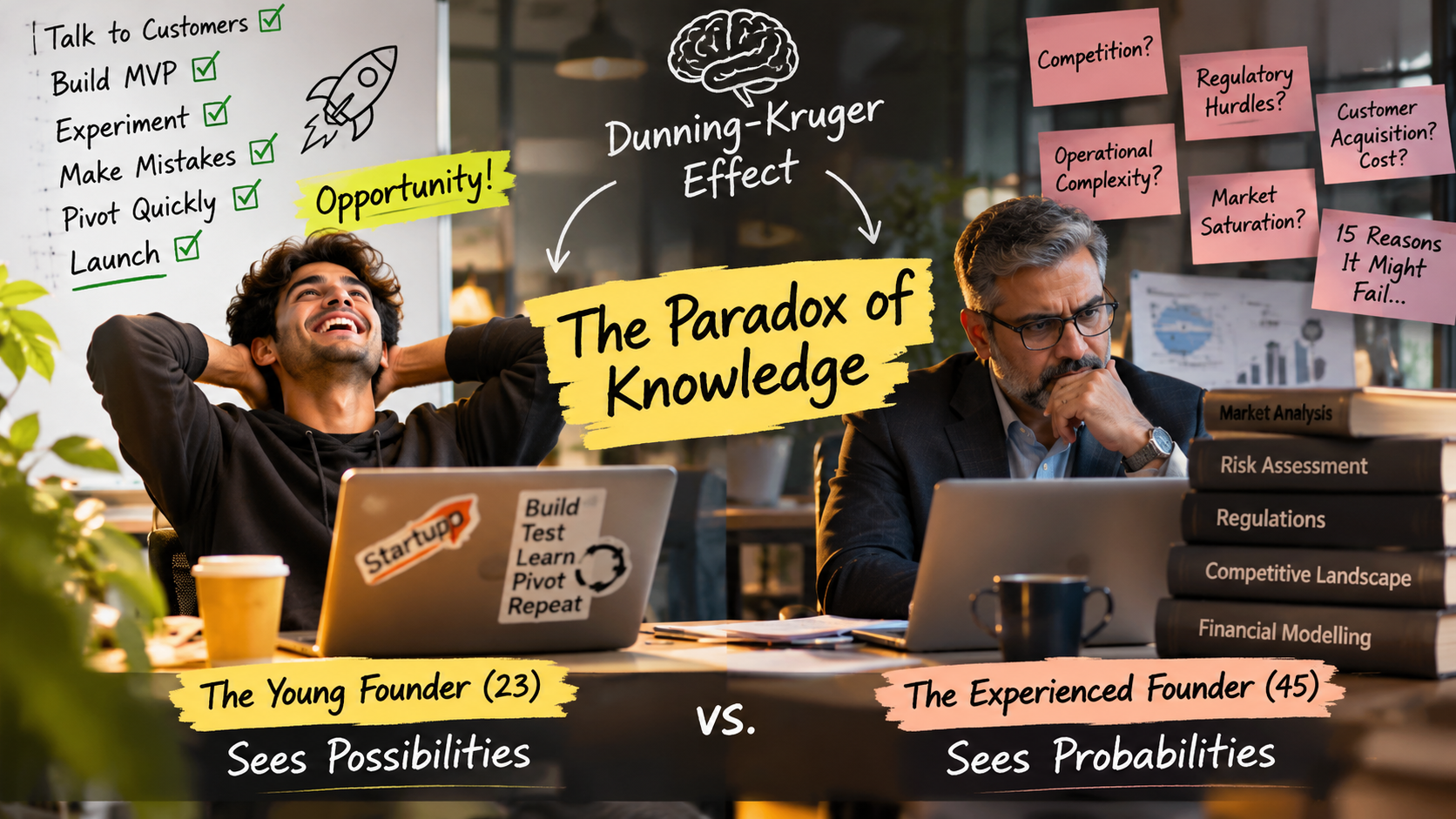
A 23-year-old with little industry experience launches a startup, experiments, makes mistakes, pivots quickly and builds a business.
Meanwhile, a 45-year-old industry veteran, armed with decades of experience and deep market insights, is still refining the business model!
Welcome to the paradox of knowledge.
The Dunning-Kruger effect describes how people with limited competence may overestimate their abilities, while experts better recognise what they don’t know.
Now, apply this to entrepreneurship.
The inexperienced founder sees an opportunity.
The experienced founder sees the opportunity, competition, regulatory hurdles, operational complexities, customer acquisition costs and fifteen reasons why the idea might fail!
One sees possibilities. The other sees probabilities.
And therein lies the paradox.
Knowledge helps us understand risks. But excessive analysis can magnify those risks until every opportunity looks like a potential disaster.
Young founders often enjoy the luxury of ignorance.
They challenge industry conventions, aren’t paralysed by memories of failure and have fewer reputations to protect.
Most importantly, they act before they have all the answers.
Because startups are rarely won by those with the best ideas or the most comprehensive PowerPoint presentations.
They are won through execution, speed, experimentation and adaptability.
While one founder prepares a detailed market-entry strategy, another has spoken to fifty customers, launched an imperfect product and discovered things no research report could have predicted.
Of course, ignorance isn’t a business strategy!
Overconfidence can destroy ventures just as easily as overthinking can prevent them from taking off. And the Dunning-Kruger effect doesn’t suggest inexperienced founders are more likely to succeed.
Experience brings enormous advantages.
Industry insights, networks, financial discipline and the wisdom to distinguish setbacks from flawed business models.
An experienced founder can build a bigger, stronger and more sustainable venture.
Provided experience becomes an accelerator, not an anchor.
The challenge is knowing when to analyse and when to experiment. When to trust experience and when to let the market prove you wrong.
Perhaps the ideal entrepreneur combines the curiosity of a beginner, the energy of a youngster and the judgment of a veteran.
Knowledge should help us make better decisions, not postpone them indefinitely.
Is your knowledge helping you build your venture faster, or has it become the most sophisticated excuse for not moving forward?