
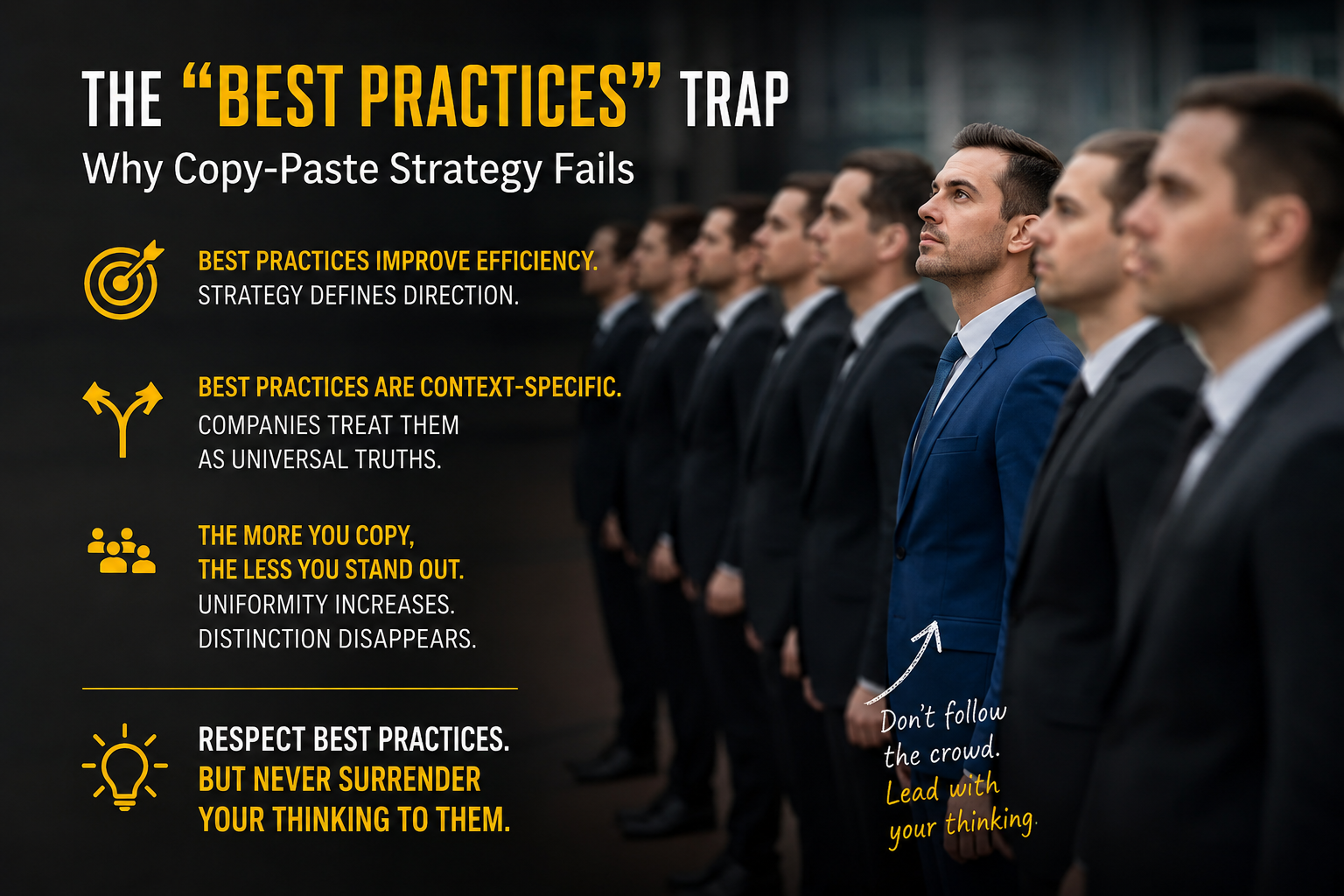
Walk into any boardroom today and you’ll hear a familiar line: “Let’s adopt global best practices.” It sounds smart. Safe. Sensible. It also sounds like the beginning of strategic mediocrity. Because when every company starts doing what the “best” companies have already done… who exactly is left to be the best?
Here’s the uncomfortable truth:
Best practices don’t create leaders. They create followers… who execute brilliantly and still remain invisible.
Most companies don’t fail because they lack capability.
They fail because they outsource thinking.
They benchmark. They compare. They replicate.
And somewhere in that process, they dilute their own identity.
What worked for a multinational with deep pockets, global distribution, and decades of brand equity…
is now being force-fitted into a mid-sized Indian company operating in a completely different reality.
Same slides. Same frameworks. Same jargon.
Different context. Same disappointment.
As Peter Drucker famously said:
“There is nothing so useless as doing efficiently that which should not be done at all.”
Yet, companies obsess over doing things right… instead of questioning whether they are doing the right things.
Let’s call out the trap:
– Best practices are context-specific. Companies treat them as universal truths.
– Best practices standardize operations. Strategy must differentiate positioning.
– Best practices improve efficiency. Strategy defines direction.
And direction cannot be copied.
Because strategy is not a template.
It is a set of choices.
Choices about where to play.
Choices about what to ignore.
Choices about what to double down on… even when others aren’t.
But here’s the irony:
The more companies chase “best practices”…
the more they start looking, sounding, and behaving the same.
Uniformity increases. Distinction disappears.
And in markets where customers are spoilt for choice… being “as good as everyone else” is the fastest route to irrelevance.
Think about the companies that truly stand out.
They didn’t ask, “What is everyone else doing right?”
They asked, “What is everyone else missing?”
That’s the shift.
– From benchmarking to belief building
– From imitation to intentional differentiation
– From following playbooks to writing their own rules
Because markets don’t reward the most compliant company.
They reward the most compelling one.
So the next time your team proposes adopting “best practices,”
don’t reject it outright.
But don’t accept it blindly either.
Pause. Interrogate. Contextualize.
Ask the harder questions:
– Does this align with our reality… or someone else’s success story?
– Are we solving our problem… or copying their solution?
– If everyone adopts this, where is our edge?
And perhaps the real best practice for companies today is this:
Respect best practices. But never surrender your thinking to them.