
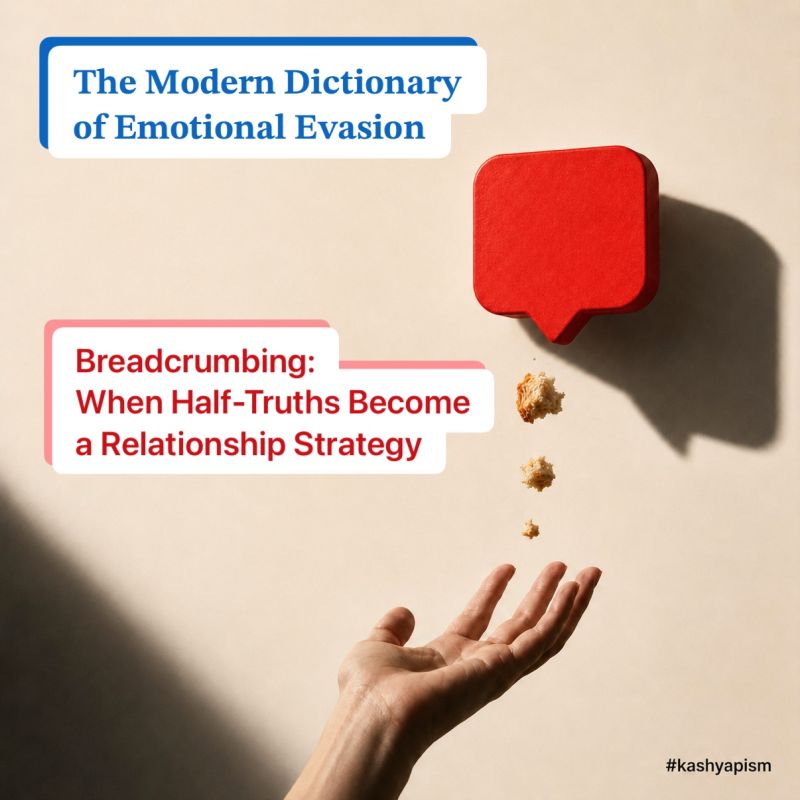
We now have sophisticated labels for almost every form of emotional ambiguity. The behaviours are hardly new; they have simply undergone an impressive rebranding. Every week, I will decode one such fashionable term and the uncomfortable truth concealed beneath it.
Let us begin with: # Breadcrumbing.
Traditionally, breadcrumbing means giving someone small, irregular doses of attention to keep them interested without offering clarity or commitment.
But there is a more sophisticated version.
You feed people carefully selected pieces of information: enough to keep them emotionally invested, but never enough to let them understand the complete equation.
You reveal what creates closeness.
You hide what may create questions.
You share what supports the image.
You label everything else “private.”
Very elegant.
Manipulation has apparently hired a branding consultant.
Of course, everyone deserves privacy. Nobody is required to livestream every thought, conversation or relationship.
But privacy means protecting your personal space.
Breadcrumbing means controlling another person’s understanding so that the relationship continues on terms convenient to you.
Sometimes it is not malicious.
People may fear judgement, conflict or abandonment. They may be emotionally immature, confused or simply incapable of having an honest conversation.
But lack of malicious intent does not eliminate emotional impact.
Because the relationship remains superficial because the other person is bonding with a curated version of you.
You are not sharing yourself.
You are managing their perception of you.
And eventually, people notice.
They notice the missing context and conveniently edited answers.
First, they ask questions.
Then they doubt themselves.
Finally, they stop asking.
That is when they detach.
Not because your breadcrumbing successfully fooled them forever, but because they realised that continuously decoding you was not a relationship.
The amusing part is that people who breadcrumb often believe they are managing everyone intelligently.
Perhaps.
But while others may not know every fact, they can usually sense when something does not add up.
So you may be fooling them temporarily.
But the person you are fooling permanently is yourself.
So ask yourself:
– Are you protecting your privacy or protecting your carefully manufactured image?
– Would the relationship remain unchanged if the other person knew the complete context?
– And when they finally detach, did they misunderstand you or did they finally understand the pattern?
Next month, we will decode another such fashionable term.
And please, breadcrumb responsibly. Someone may already understand the pattern better than you think.