
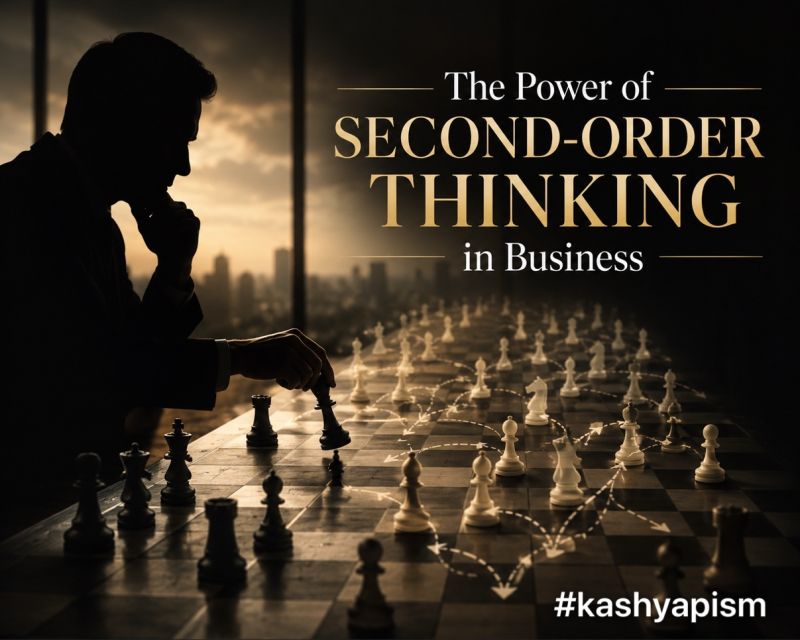
“We have decided.” Those three words have built great companies as it shows clarity of the promoters. And destroyed many more companies as sometimes it shows lack of judgement because of poor understanding of prevailing business scenario.
It’s not because the decision was wrong. But because no one asked the next question: “And then what?”. That is the difference between ordinary thinking and second-order thinking.
Most business leaders evaluate the first consequence of a decision. Strategic leaders think about the second, third and fourth consequences. It’s like playing chess where your current move should factor in the possible next few moves too.
Because in business, the biggest risks rarely arrive immediately. They arrive quietly, months later. Consider a few examples:
a) A promoter decides to reduce prices by 15%. The immediate outcome? Sales increase. But what happens six months later. Margins shrink. Competitors match the price cut. Customers begin waiting for discounts. The brand slowly becomes known for being cheaper rather than better. The problem was never the discount. It was the consequences that followed.
b) A ?150 crore company appoints a professional CEO. Everyone applauds the decision. But the promoter continues approving every major decision, negotiating every key customer contract and wants all division heads to send him daily updates. The organisation now has two CEOs. One with authority and the other with influence. The issue wasn’t hiring a CEO. It was failing to redesign the founder’s role.
Second-order thinking would have anticipated this. The reality is that strategy is rarely about predicting the future. It is about anticipating reactions – of customers, competitors, employees, markets, investors and all the other stakeholders.
And sometimes, your own success creates your next challenge. This is why the best promoters I have worked with rarely ask only, “Will this work?”. Instead, they keep asking: “What happens next?”… “And after that?”… “And if our competitors copy us?”… “And what new problem will this create?”… Those questions don’t slow decision-making but improve it.
Perhaps that is why Warren Buffett once said: “Chains of habit are too light to be felt until they are too heavy to be broken.” The same is true for business decisions as every decision creates a chain reaction. The question is whether you can see beyond the first link. Because first-order thinking solves today’s problem whereas the second-order thinking builds tomorrow’s advantage.
So before your next board meeting, before approving your next investment, before entering a new market or launching a new product…
Pause for a moment and ask yourself:
What happens next?
and if this decision succeeds, what new challenge will it create?