
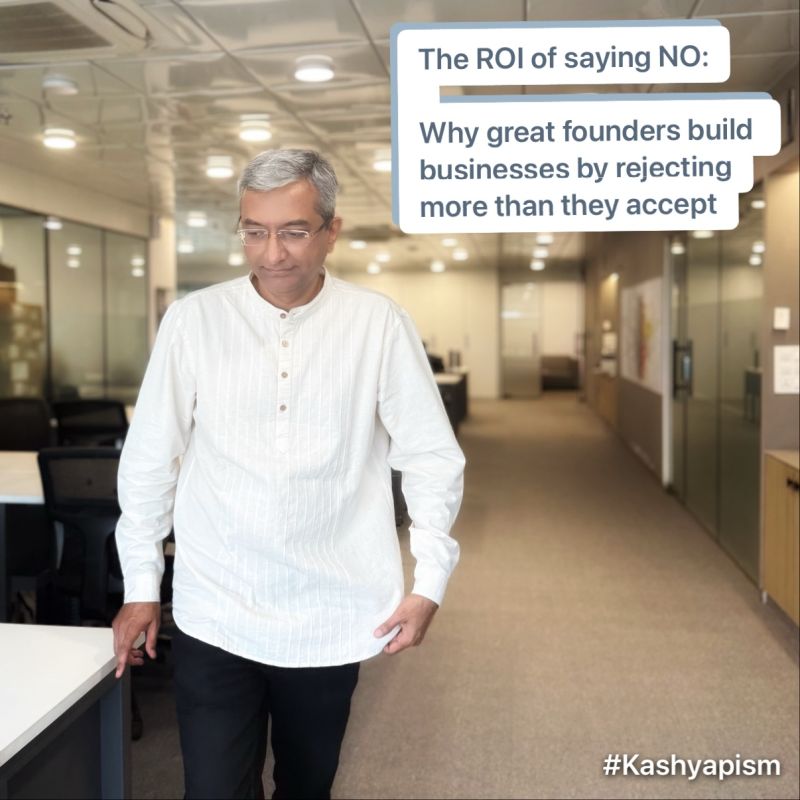
Some of the biggest business disasters don’t happen because founders said NO too often. They happen because they kept saying YES for too long.
YES to every opportunity.
YES to every client request.
YES to every partnership.
YES to every trend.
YES to every “easy revenue” idea.
And slowly, the startup stops building a business…
and starts collecting distractions.
Because every YES has a hidden cost:
Time. Focus. Energy. Positioning. Culture.
The problem is, saying YES feels optimistic.
Saying NO feels risky.
But the truth is:
Most great companies are built not just by what they chose to do…
but by what they refused to become.
As Steve Jobs said:
“Focus is about saying no.”
Early-stage founders struggle with this the most.
A SaaS startup becomes a services company because one client asked.
A D2C brand starts chasing enterprise customers.
A founder spends more time attending networking events than talking to customers.
Soon, the company looks less like a strategy…
and more like a confused buffet plate at a wedding.
Too many founders confuse movement with direction.
And sometimes, the inability to say NO reveals something deeper:
Lack of clarity.
Or lack of conviction.
Because when you truly know where you are going, decisions become easier.
You stop asking:
“Can we do this?”
And start asking:
“Should we do this?”
That shift changes everything.
And here’s another important truth:
Sometimes the smartest NO is saying NO to something you had once enthusiastically said YES to.
Because markets evolve.
Customers evolve.
Founders evolve.
What felt strategic 18 months ago may now feel completely misaligned.
And there is nothing wrong in changing direction.
The real mistake is dragging old decisions long after your understanding has changed.
Because then two businesses start running together:
The old one you no longer believe in…
and the new one you secretly want to build.
That creates confusion for everyone:
Your team.
Your customers.
And most importantly, yourself.
Warren Buffett once said:
“Really successful people say no to almost everything.”
Not because they are negative.
But because focus compounds.
Every strong NO sharpens identity.
In a noisy world, clarity is a superpower.
So maybe the real question is not:
“What opportunities am I missing by saying NO?”
Maybe it is:
“What future am I delaying because I keep saying YES?”