
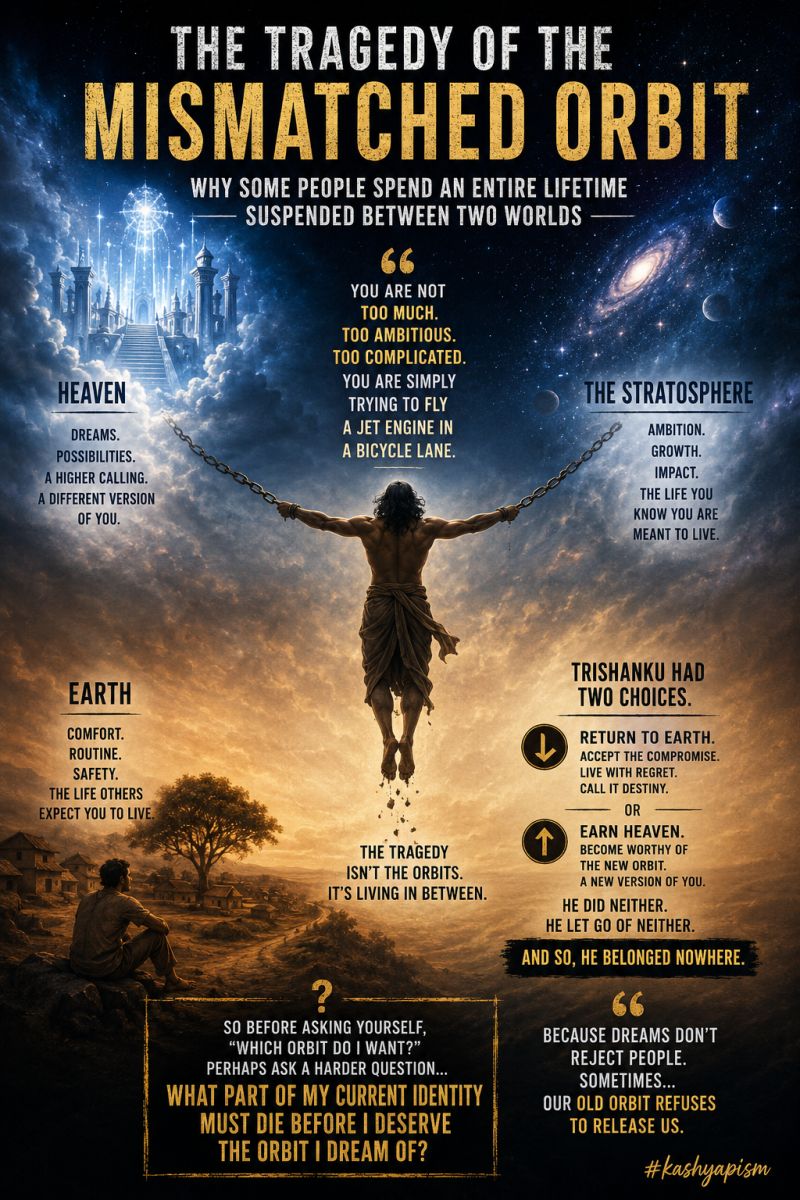
The cruelest fate isn’t rejection. It’s never truly belonging anywhere.
Every human life eventually asks one question:
“Which orbit are you willing to call home?”
Trishanku chose neither. Or perhaps, he couldn’t.
He wasn’t allowed into heaven.
He couldn’t return to earth.
And so, he remained suspended between two worlds – belonging to neither, leaving neither.
Perhaps that is one of the greatest tragedies a human being can experience.
Not failure. Not rejection.
But spending an entire lifetime trapped between two orbits.
Some people are born with dreams that belong to the stratosphere.
They are uncomfortable with unrealized potential.
And yet…
They spend their lives seeking validation from people perfectly content with a lower orbit.
There is nothing wrong with that lower orbit.
A peaceful life…
A stable income…
Predictable routines…
That is a beautiful choice.
But it is a tragedy when someone designed for higher altitudes keeps grounding themselves just to make everyone else comfortable.
The greatest cost isn’t that others fail to understand you.
The greatest cost is that, slowly, you begin to misunderstand yourself.
Every compromise feels small.
Until one day you realise you have negotiated away the very dream that once defined you.
Then comes the dangerous consolation.
You call it maturity.
You call it destiny.
You call it peace.
Sometimes it genuinely is.
But sometimes…
It is simply ambition wearing the mask of acceptance.
Every orbit demands a price.
A lower orbit asks you to sacrifice possibility for predictability.
A higher orbit asks you to sacrifice comfort for uncertainty.
Neither is superior.
But the orbit you commit to eventually defines you.
Perhaps Trishanku had only two choices.
He could have returned to earth…
Buried his extraordinary dream.
Found peace in compromise.
And lived with the quiet regret of never discovering who he could have become.
Or…
He could have truly earned heaven… by becoming worthy of the new one.
Because every higher orbit demands a different version of you.
You cannot keep the gravity of your old world and expect to survive in a new one.
Perhaps that was Trishanku’s real tragedy.
He wasn’t willing to return to earth.
But neither was he willing to completely let go of the beliefs, attachments, and identity that belonged to his old orbit.
And so…
He belonged nowhere.
Maybe that’s why so many brilliant people feel like Trishanku.
Unable to settle…
Unable to soar…
So before asking yourself…
“Which orbit do I want?”
Perhaps ask a harder question…
“What part of my current identity must die before I deserve the orbit I dream of?”
Because dreams don’t reject people.
Sometimes…
Our old orbit refuses to release us.