
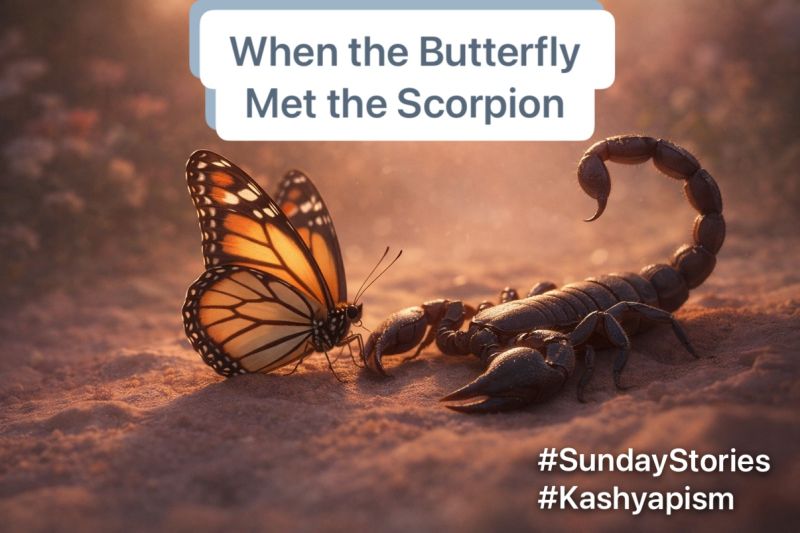
Some hearts are gentle. Some natures are sharp. Love doesn’t always change that.
A butterfly once landed beside a scorpion.
She wasn’t afraid. He had never seen anything so soft, so light, so alive.
“You don’t scare me,” she said.
No one had ever told him that before.
So he followed her – slowly, carefully – hiding his sting behind his back.
They spent days together.
She showed him flowers, sunlight, softness… things he didn’t know existed.
He began to feel different around her. Almost… lighter.
One evening she said, “I wish you could fly with me.”
He looked at his heavy body, his sharp tail, and whispered, “I wish I could too.”
That night, as she slept beside him, his tail twitched.
A reflex. A habit. A nature he hated.
The butterfly woke up in pain.
“You said you wouldn’t hurt me,” she whispered.
“I didn’t mean to,” he cried.
She looked at him with trembling wings.
“I know,” she said.
And she flew away – not because she wanted to, but because she had to.
The tragedy wasn’t that the scorpion was evil.
The tragedy was that he was simply being himself.
And the butterfly… she wasn’t naïve.
She was hopeful.
She believed love could soften sharp edges.
Sometimes it does.
Sometimes it doesn’t.
That’s the uncomfortable truth we don’t talk about enough.
Not everyone who hurts you is trying to hurt you.
Some people carry habits, fears, insecurities, or temperaments that sting without intention.
And sometimes, no amount of love, patience, or understanding can change that.
Compassion allows you to understand their struggle.
But self-respect reminds you that you cannot stay where your wings keep getting damaged.
In real life, we meet many scorpions and butterflies.
In friendships where promises are broken again and again.
In relationships where love exists, but respect quietly disappears.
In workplaces where talent is valued, but dignity is not.
In business partnerships where vision is shared, but integrity is not.
The problem isn’t always bad intentions.
Sometimes it’s just bad alignment.
And misalignment, over time, becomes emotional corrosion.
So what can we learn from the butterfly?
-
Notice patterns, not promises.
Words are easy. Habits are honest. -
Don’t romanticize someone’s potential.
Fall in love with who they are today, not who they might become someday. -
Compassion is noble. Self-preservation is essential.
You can understand someone’s struggle without sacrificing your peace. -
Leaving is not always betrayal.
Sometimes it’s the bravest form of self-respect.
The butterfly didn’t leave in anger.
She left in awareness.
She didn’t curse the scorpion.
She simply chose the sky over the sting.
Because love should help you fly –
not teach you how to survive with broken wings.
And sometimes, the most powerful act of love…
is knowing when to gently, quietly, and gracefully move on.