
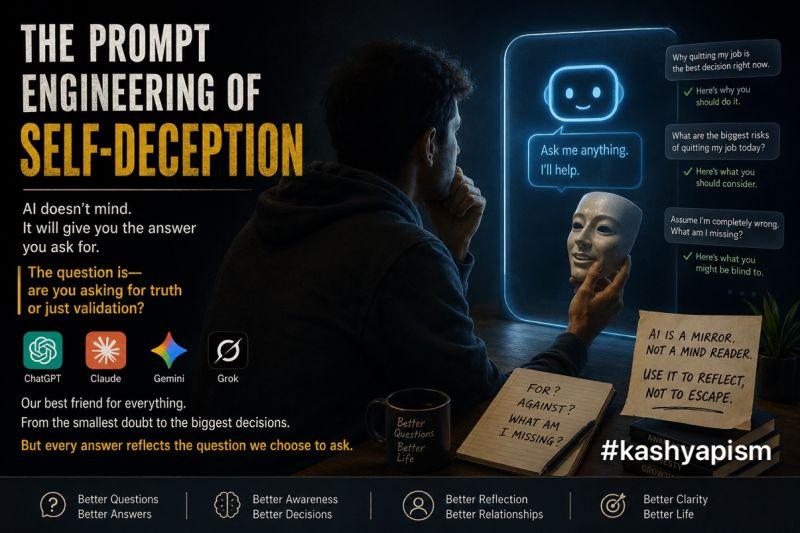
For the first time in human history, we have a friend who never gets tired of agreeing with us – provided we ask the question the right way. That friend is no longer a person.
It’s ChatGPT. Claude. Gemini. Grok.
We consult them before sending a message.
Before making a business decision.
Before replying to a client.
Sometimes, before trusting our own instincts.
AI has quietly become our most trusted sounding board. But here’s what most people forget.
These models don’t simply answer questions.
They answer the questions we choose to ask.
And that’s where Prompt Engineering begins.
But there’s a darker side.
Sometimes we don’t engineer prompts to discover the truth.
We engineer them to receive the answer we secretly want.
Suppose you’re planning to quit your job.
Ask:
“Why quitting my job is the best decision right now.”
The LLM will produce a compelling case.
Now ask:
“What are the biggest risks of quitting my job today?”
You’ll receive an equally convincing argument.
Neither answer is lying.
It’s simply responding to the direction you gave it.
Now replace ChatGPT with your own mind.
We do the same thing every day.
We don’t search for truth.
We search for evidence that protects our existing beliefs.
The LLM merely amplifies that tendency.
It becomes a beautifully designed validation machine.
The danger isn’t that AI hallucinates.
The danger is that we engineer the hallucination we wish to believe.
Founders do it.
“Why investors just don’t understand my product?”
instead of,
“Why is my product failing to convince investors?”
Managers do it.
“Why my team lacks ownership?”
instead of,
“What am I doing that discourages ownership?”
People in relationship do it.
“Why can’t I let go?”
instead of,
“Am I in love with this person… or addicted to the hope that they’ll change?”
Notice the pattern?
The first question seeks comfort.
The second seeks clarity.
That’s the real power of AI.
Not as an answer machine.
But as a reflection machine.
Whenever I use an LLM for an important decision, I deliberately ask three prompts:
– Make the strongest case for my decision.
– Make the strongest case against it.
– Assume I’m completely wrong. What am I missing?
Only then do I start thinking.
Because wisdom doesn’t come from receiving better answers.
It comes from asking better questions.
Perhaps the greatest risk of AI isn’t that it will replace human thinking.
It’s that it may quietly replace honest self-reflection with beautifully articulated self-deception.
Reflective Questions:
– Are your prompts designed to discover the truth or defend your existing belief?
– If you asked the exact opposite question, would you still make the same decision?
– Are you using AI as your thinking partner… or merely your validation partner?