
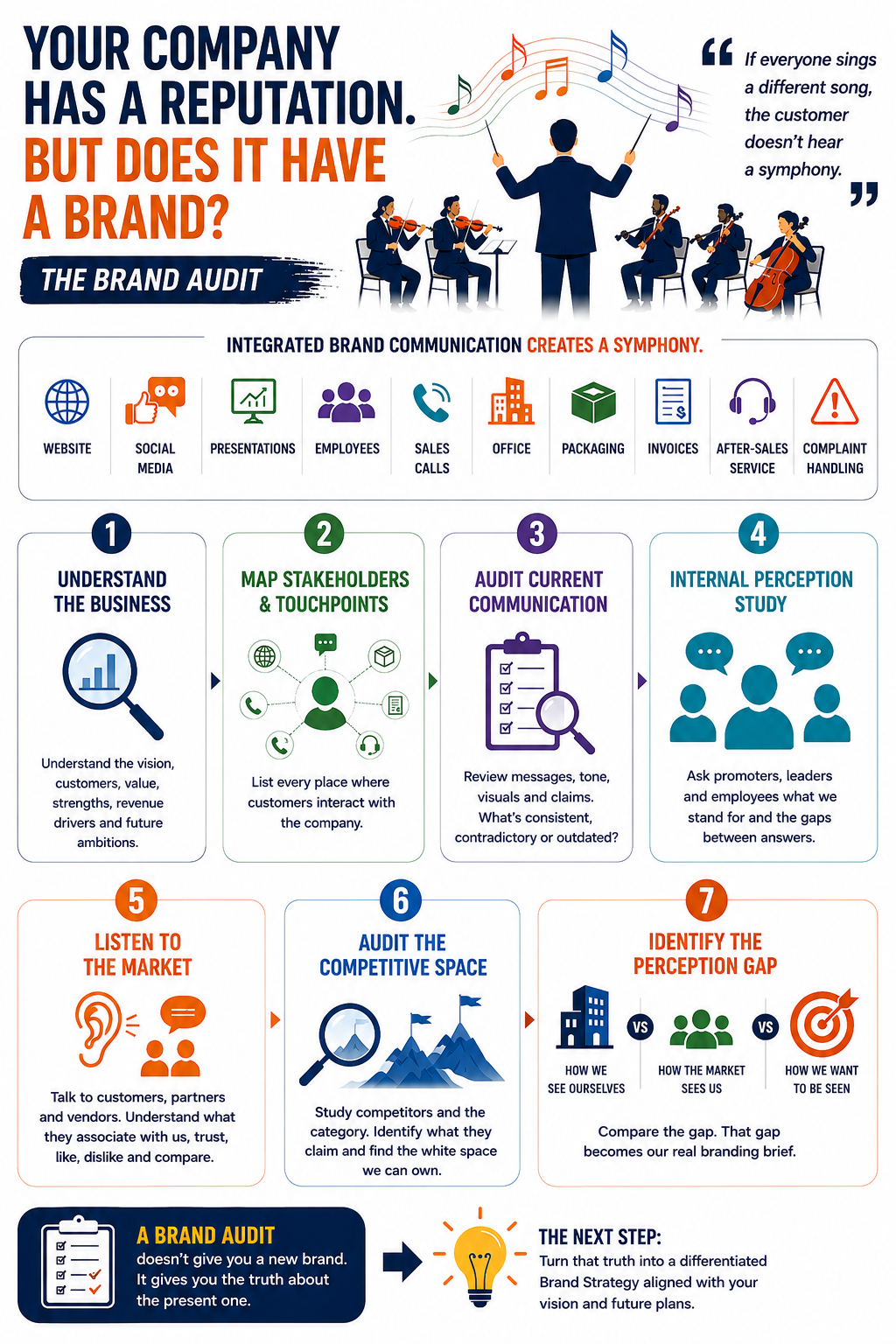
If your website, sales presentation, social media and employees describe your company differently, you do not have integrated brand communication. You have several people playing different songs and hoping the customer hears a symphony.
Many successful companies reach this stage after twenty years. They have grown through quality, relationships, referrals and the founder’s credibility. The market respects them.
The problem is that this perception was accumulated, not consciously crafted.
Ask ten employees what the company stands for and you may receive twelve answers. The website says “innovation.” The sales team sells “competitive pricing.” The founder talks about “trust.” The brochure promises everything from quality to world peace.
This becomes risky when the company wants to enter new markets, attract talent or prepare for its next growth phase.
That is when branding must move from decoration to strategy.
But do not begin with a new logo or a fashionable tagline or a fancy website. Begin with a Brand Audit.
1) Understand the business:
Review the vision, growth plans, customer segments, revenue drivers, strengths and future ambitions. Understand what value it creates, for whom, why customers choose it and where the company wants to go.
2) Map stakeholders and touchpoints:
List every place where customers experience the company: website, social media, packaging, proposals, sales calls, office, invoices, after-sales service and complaint handling.
3) Audit current communication:
Study the messages, tone, visuals and claims across these touchpoints. What is repeated, contradictory or outdated? Is the promise made in communication delivered in the actual experience?
4) Conduct an internal perception study:
Ask promoters, leaders and employees what the company stands for, why customers choose it, what makes it different and what it must never compromise on. The gaps between answers are often more revealing than the answers.
5) Listen to the market:
Interview customers, partners and vendors. Ask what they associate with the company, why they trust it, where it falls short and how it compares.
6) Audit the competitive space:
Study how competitors position themselves and what the category repeatedly claims. The purpose is not to copy the best competitor, but to identify an empty space your brand can credibly own.
7) Identify the perception gap:
Compare how the company sees itself, how the market sees it and how it wants to be seen. That gap becomes the real branding brief.
A Brand Audit does not give you a new brand. It gives you the truth about the present one.
The next step is to turn that truth into a differentiated Brand Strategy aligned with the company’s vision and future plans.
That is what Part 2 of this series will explore tomorrow.