
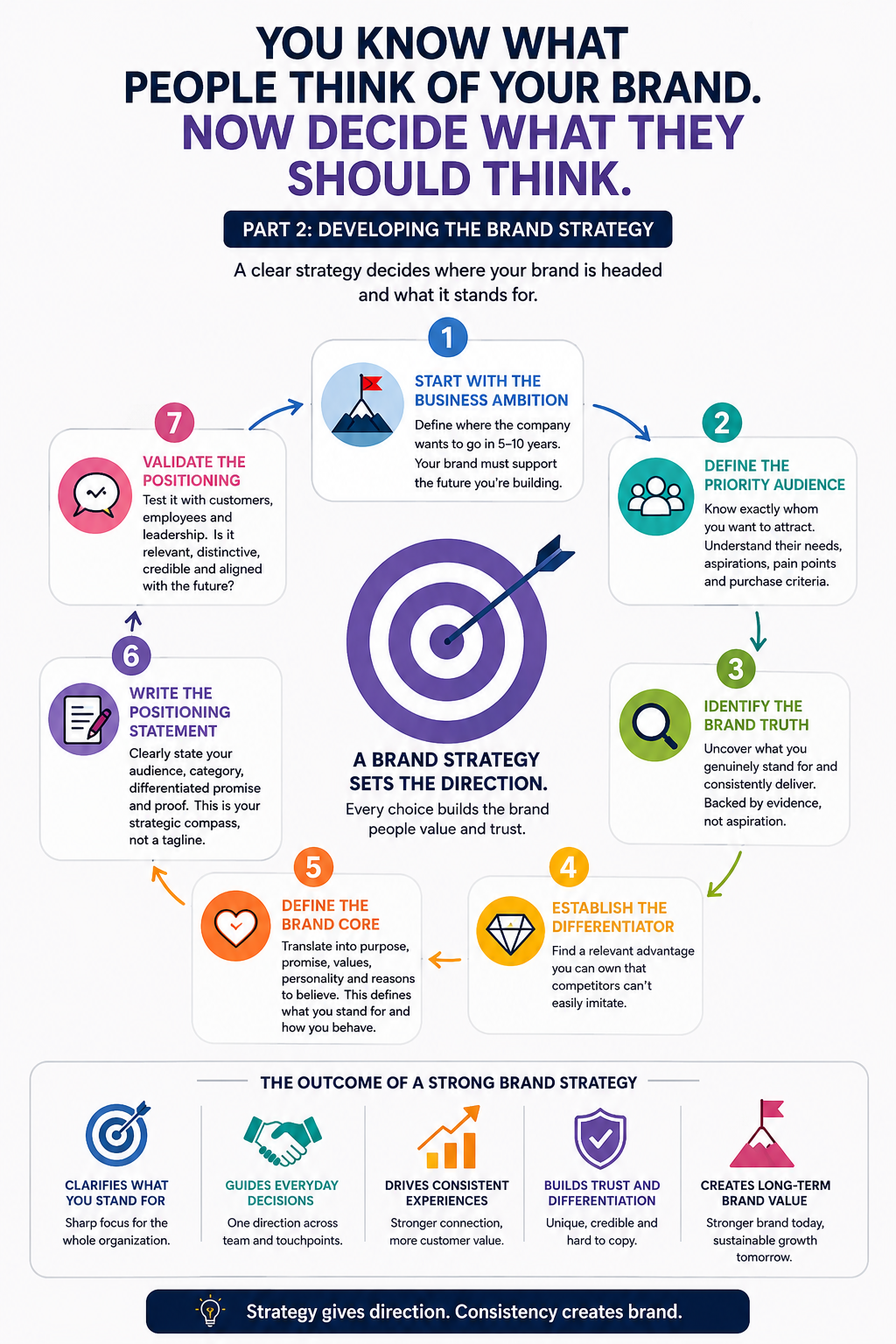
A Brand Audit tells you where your brand stands. A Brand Strategy decides where it should go.
In Part 1, we explored how to conduct a Brand Audit and understand where your brand currently stands.
Now comes the harder part: deciding what you want it to stand for.
Because Brand Strategy is ultimately an exercise in making choices.
Here is how you develop it:
1) Start with the business ambition:
Where does the company want to go over the next five to ten years? Your positioning must support the company you are building, not merely describe the company you are running.
2) Define the priority audience:
Define precisely whom the brand wants to attract. Understand their needs, aspirations, pain points and purchase criteria, not merely their demographics. A brand must know exactly whose mind it wants to occupy.
3) Identify the brand truth:
Review the audit findings to uncover what the company genuinely stands for and consistently delivers. Look for recurring strengths, customer perceptions and organisational beliefs supported by evidence, not aspiration.
4) Establish the differentiator:
Study how competitors position themselves and what customers value in the category. Then identify a relevant advantage your company can credibly own and competitors cannot easily imitate.
5) Define the Brand Core:
Translate this differentiator into the brand’s purpose, promise, values, personality and reasons to believe. Together, these define what the brand stands for and how it should behave.
6) Write the positioning statement:
Clearly articulate the target audience, category, differentiated promise and supporting proof. This is not the tagline. It is the strategic compass that guides communication and customer experience.
7) Validate the positioning:
Test it with select customers, employees and leadership. Is it relevant, distinctive, credible and aligned with the company’s future?
If customers do not value it or employees cannot deliver it, it is not yet a positioning. It is merely a presentation.
A strong Brand Strategy does more than shape communication. It aligns how the company wants to grow with how it wants to be perceived.
It gives the organisation clarity about what to stand for, what to consistently deliver and what not to become.
But positioning creates value only when it moves from a presentation into everyday decisions, behaviour and experiences.
In Part 3, we will explore how to translate Brand Strategy across communication, culture and every customer touchpoint, turning a strategic intent into a consistent brand and, ultimately, measurable business value.