
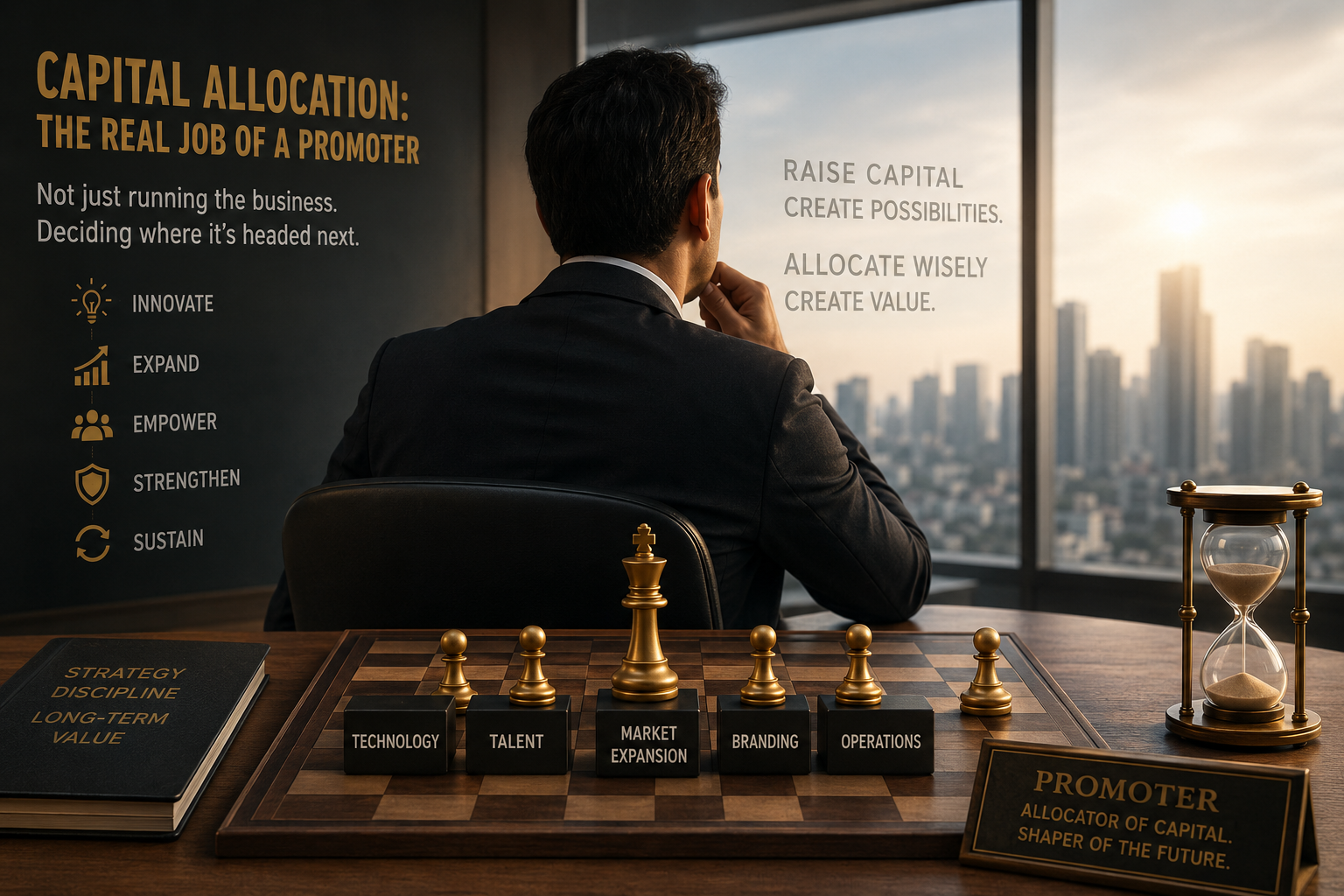
What is the real job of a promoter: to innovate, sell, manage operations, build teams or ensure that all of these happen without their constant involvement?
In the early years, the promoter does almost everything.
Finds customers. Negotiates with suppliers. Approves payments. Interviews employees. Resolves complaints. And occasionally finds time to think about strategy.
This involvement is necessary. The business survives because the promoter is everywhere.
But as the company grows, the promoter’s role must evolve.
With an experienced team, defined systems and established processes, the business no longer needs the promoter to solve every operational problem. It needs the promoter to decide where its money, talent and attention should be invested.
Capital allocation is not simply about spending money. It is about deciding where the next rupee can create the greatest long-term value.
Should the company expand capacity or improve utilisation?
Enter a new market or strengthen the existing one?
Invest in technology, talent, branding or distribution?
Acquire another business, reduce debt or preserve cash?
Each decision shapes the future of the enterprise.
Successful promoters are usually good at two things: raising capital on the right terms and deploying it with discipline.
Raising capital creates possibilities. Allocating it wisely creates value.
Yet many promoters remain trapped in the role that made them successful. They continue approving routine purchases, following up on sales, attending operational reviews and resolving problems their managers should handle. It turns the promoter into the company’s most expensive operations manager.
Such businesses rarely scale effectively.
Every hour spent supervising routine execution is an hour not spent evaluating opportunities, building leadership, strengthening competitive advantage or deciding the company’s next big bet.
Scaling therefore requires a shift from controlling activities to allocating resources.
The promoter must stop asking, “How should this task be done?” and start asking, “Should we be doing this at all?”
The promoter must remain close enough to understand the business, but not so involved that the business becomes dependent.
The promoter’s evolution is simple, but rarely easy:
First, you run the business.
Then, you build an organisation that runs it.
Finally, you decide where that organisation should invest its capital and attention to create the next phase of value.
So, ask yourself:
Am I managing today’s activities or shaping tomorrow’s enterprise?
Which investments are strategic, and which are emotional?
Where should our next rupee and next leadership hour be deployed?
Because hard work may build a successful business.
But intelligent capital allocation builds a valuable institution.