
A few days ago, while discussing a growth strategy with a promoter, I asked him an uncomfortable question:
“Assume we are sitting here 18 months later and this strategy has failed miserably. What went wrong?”
He laughed.
“Normally consultants are called after things go wrong to do the post-mortem.”
Exactly.
But by then, the patient is already dead.
So why not conduct the post-mortem before executing the strategy?
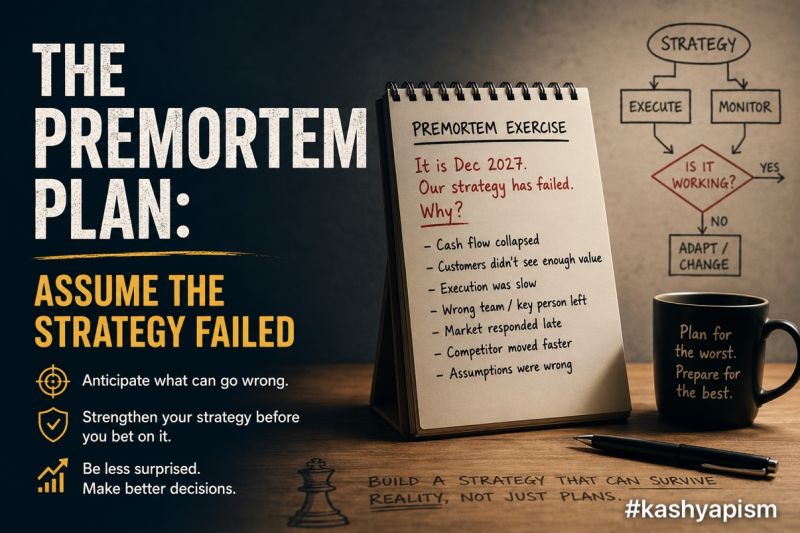
That is the idea behind a Premortem Plan.
Most strategy meetings begin with optimism.
How big is the opportunity?
How fast can we grow?
Which markets can we enter?
What resources will we need?
All valid questions.
But once people fall in love with a strategy, they unconsciously start defending it.
The spreadsheet becomes ambitious.
Assumptions become convenient.
And dissent quietly leaves the meeting room.
Over the years, I have seen strategies fail not because the idea was fundamentally wrong, but because of far less glamorous reasons: inadequate working capital, the wrong person leading it, delayed execution, channel resistance, promoter bandwidth, weak middle management or simply the market taking six months longer to respond than Excel had politely assumed.
A premortem brings these uncomfortable possibilities to the table.
The exercise is simple.
Once the strategy is defined, gather the people who will actually execute it and declare:
“It is December 2027. This strategy has failed. Write down why.”
Individually first. Discussion later.
The CFO may say cash flow collapsed.
Sales may say customers never saw enough value.
Operations may say capacity couldn’t keep pace.
And a younger manager may point out something everybody knew but nobody wanted to tell the promoter.
That last one can sometimes be worth the entire exercise.
Now classify the risks:
What could kill the strategy?
What could delay it?
What could merely hurt it?
Then work backwards.
If distributor resistance could kill expansion, test distributors before investing heavily.
If the plan needs ?20 crore of working capital, ask what happens if it needs ?30 crore.
And if success depends on every assumption behaving exactly as predicted, you don’t have a strategy. You have a prayer.
A robust strategy needs warning signals, fallback options and predefined points where management agrees to pause, modify or even abandon the plan.
Because once execution begins, people become attached not just to the strategy, but to being proven right.
A premortem allows you to challenge the strategy before reputations become attached to it.
So before approving your next big strategy, ask:
What are we assuming must go right?
What does my team already worry about but hesitate to tell me?
And most importantly:
Are we confident because our strategy is robust… or because nobody has tried hard enough to break it yet?