
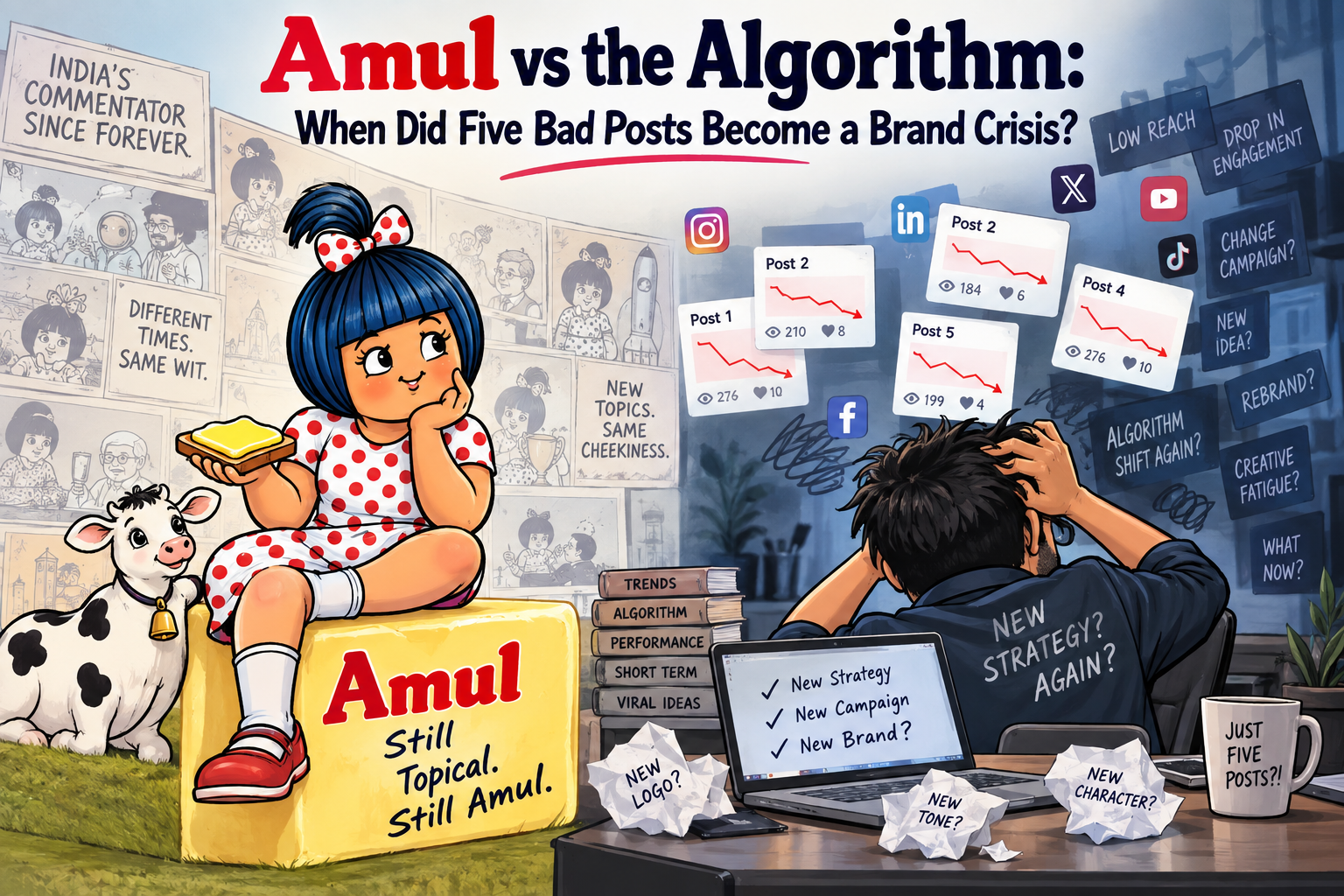
The algorithm has probably killed more good brand ideas than bad advertising ever did.
Five posts underperform. Reach drops. Engagement dips. And suddenly, everyone wants a new strategy.
We have reached a strange place in marketing where a few bad weeks can undo months of brand thinking.
The algorithm changes, so the campaign changes.
The campaign changes, so the brand changes.
And before consumers can remember you, you have already become someone else.
And then there is Amul.
For decades, the little girl in the polka-dotted dress has commented on almost everything India has celebrated, debated, loved or hated.
Governments changed. Celebrities changed. Media changed. Consumers changed.
Eventually, even the meaning of a “post” changed.
Amul changed the topical.
It rarely changed the character.
Same visual language. Same wit. Same cheekiness. Same unmistakable Amulness.
Imagine if every few months someone at Amul had looked at the numbers and said, “The Amul Girl is showing creative fatigue. Let’s reinvent her.”
That is where Amul vs the Algorithm becomes an interesting branding lesson.
The algorithm rewards what is working now.
A brand is built by what people remember later.
The algorithm loves novelty.
Memory loves repetition.
The algorithm measures reactions.
Brands accumulate associations.
Of course, Amul has an advantage. It is a cooperative giant, not a venture-backed startup living from one investor update to another. But that makes the story only more interesting.
This is no longer a small dairy brand patiently building recognition in one market. Amul has grown into a massive organisation, expanded across categories and built a footprint far beyond India.
Yet, in a world where brands are advised to reinvent themselves every time attention shifts, Amul has continued to win something algorithms cannot manufacture overnight:
Familiarity. Affection. Trust.
Perhaps its real genius is not consistency of communication. It is consistency of character.
Because consistency does not mean saying the same thing repeatedly. It means being recognisably yourself while constantly finding something new to say.
And maybe that is where modern marketing needs a little self-check.
Are we optimising our posts so aggressively that we are de-optimising our brands?
Are we measuring what people clicked yesterday while forgetting to build what they will remember tomorrow?
And more importantly, could a new brand afford to behave like Amul today?
Or does today’s brand have to change campaigns every time the algorithm changes mood… almost as frequently as we change nappies?
That is where this debate gets more complicated.
This is the Part 1 of a 3-part series: Amul vs the Algorithm.
Next: Can a new brand afford to be this consistent in the age of the scroll?