
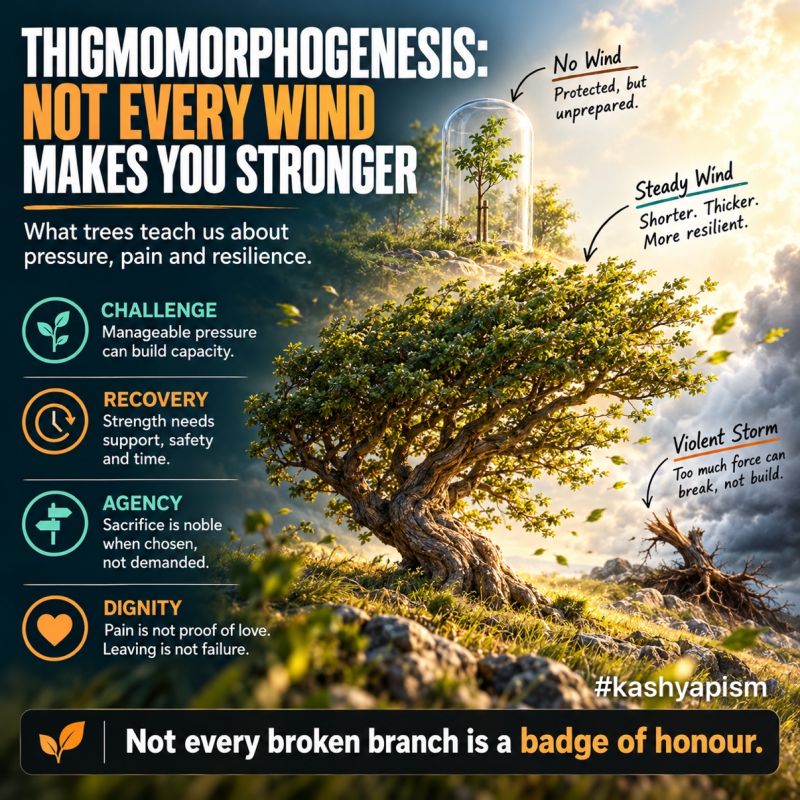
Not everything that fails to kill you makes you stronger. Some things leave you wounded and teach you to call the wound wisdom.
Botany offers a more honest metaphor.
Thigmomorphogenesis is how a plant changes its growth in response to repeated touch or movement.
When everyday wind bends a young tree, it often grows shorter and thicker, preparing for its surroundings.
The wind becomes information.
But a cyclone is not a mentor.
It can tear branches, uproot the tree and erase years of growth.
Nature knows the difference between stress that stimulates and force that destroys.
We often don’t.
Instead, we repeat tidy clichés:
“Suffering makes you stronger.”
“Sacrifice makes you noble.”
“If you truly love someone, you endure the pain.”
Perhaps we repeat them to rationalise our insecurities, hide our fears and make inaction sound like endurance.
Suffering can reveal strength. It may even develop it when the challenge is manageable, some agency remains, and there is support and time to recover.
But suffering can also shrink confidence, distort self-worth and normalise fear.
Surviving something does not prove it was necessary.
Sacrifice is not noble merely because it hurts.
A sacrifice freely chosen for a meaningful purpose can be generous.
One repeatedly demanded by a family, partner or organisation becomes exploitation wearing a halo.
Love may require patience, compromise and discomfort.
It should not demand the slow disappearance of dignity.
Pain is not proof of love.
Endurance is not always loyalty.
Leaving is not always failure.
This distinction matters in parenting, leadership and relationships.
A parent who removes every difficulty creates a windless greenhouse.
A leader who keeps people under relentless pressure creates a permanent storm.
Neither builds resilience.
One denies practice; the other denies recovery.
Before glorifying hardship, ask:
– Is this challenge expanding me or diminishing me?
– Is the sacrifice freely chosen or silently expected?
– Am I recovering, or merely functioning?
– Does staying protect the relationship, or protect a harmful pattern?
Strength is not the capacity to suffer forever.
Sometimes strength is bending.
Sometimes it is rebuilding.
Sometimes it is asking for support.
And sometimes it is walking away before the storm convinces you that broken branches are badges of honour.
A tree needs wind. It also needs roots, water, sunlight and seasons of calm.
Remove the wind entirely and it may never adapt.
Turn every day into a storm and it may never get the chance to grow.
So, which hardship truly strengthened me, and which one have I merely learnt to justify?
Which sacrifice expresses my values, and which one quietly erases them?
And am I enduring because love asks for patience, or because fear has taught me to call pain love?