
But here is the uncomfortable question:
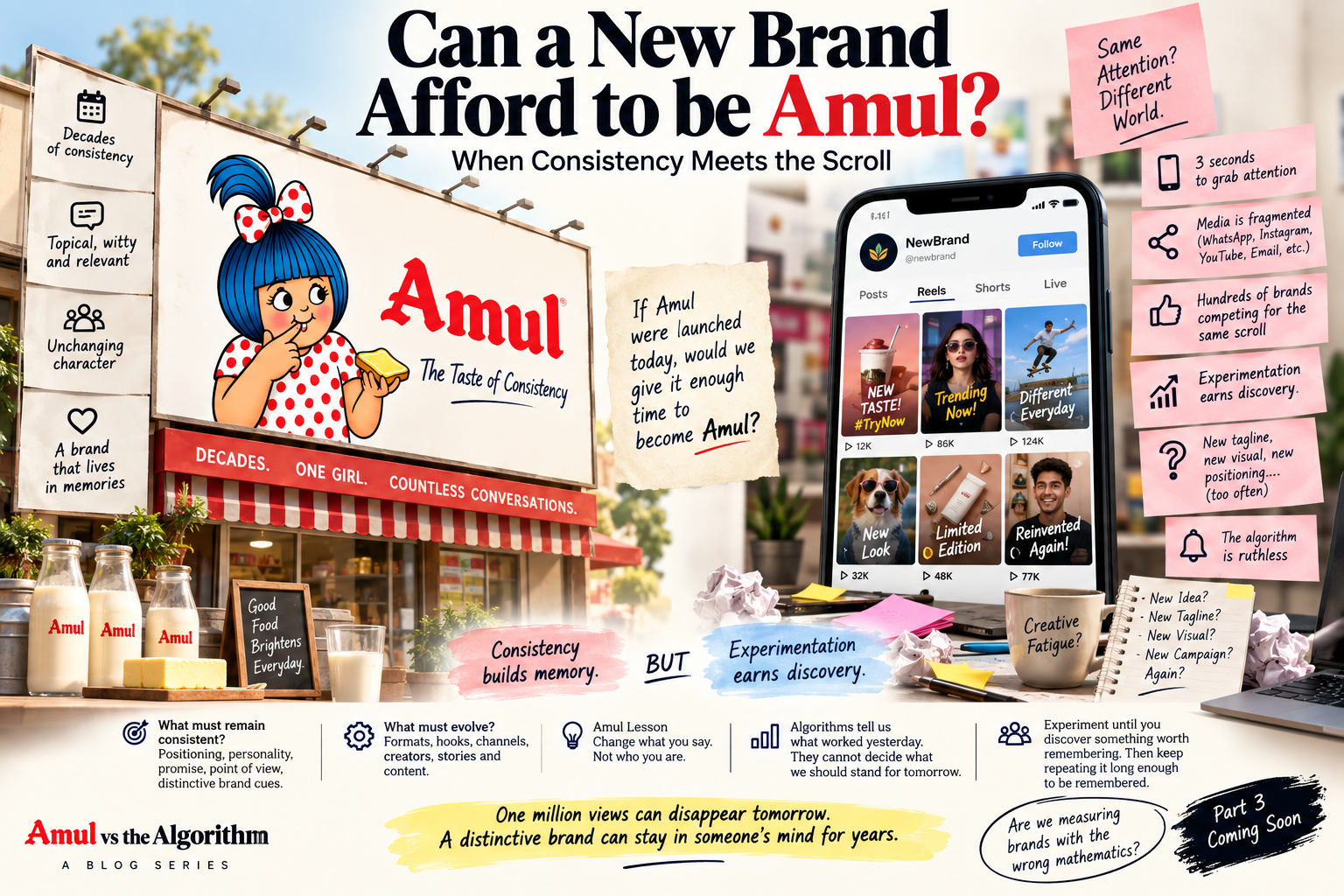
Today’s consumer wakes up to WhatsApp, scrolls Instagram, checks email, watches YouTube, encounters influencers, reels, memes, notifications, news, offers and hundreds of brands desperately waving for attention.
Media has fragmented. Attention has shrunk.
And the thumb has become ruthless.
Imagine Amul launching its topical campaign today.
Ten average posts later, the verdict arrives: “Creative fatigue.”
By the time we optimise the campaign,we may have optimised the brand out of it.
That is the paradox for new brands today.
Amul can repeat its distinctive codes because millions already recognise them.
A new brand first has to discover what deserves to be repeated.
So consistency cannot mean stubbornness.
If nobody understands your proposition, your creative is invisible and your customers are not responding, repeating it for three years is not brand building.
But the opposite is equally dangerous.
Many young brands behave like nervous teenagers.
New tagline this month. New visual language next month. New positioning next quarter.
The algorithm sneezes and the brand catches pneumonia.
Perhaps the answer lies in separating what must remain consistent from what must constantly evolve.
Your positioning, personality, promise, point of view and distinctive brand cues should build familiarity.
Your formats, hooks, channels, creators, stories and content should keep experimenting for attention.
That, perhaps, is the deeper Amul lesson.
The Amulness remains.
Algorithms can tell us what earned attention yesterday.
They cannot decide what our brand should stand for tomorrow.
So a new brand probably should not copy Amul’s strategy.
It should copy the principle.
Because one million views can disappear tomorrow.
A distinctive brand can stay in someone’s mind for years.
But that creates another problem.
If branding compounds slowly while dashboards report daily,are we measuring brands with the wrong mathematics?
That is Part 3 of Amul vs the Algorithm.