
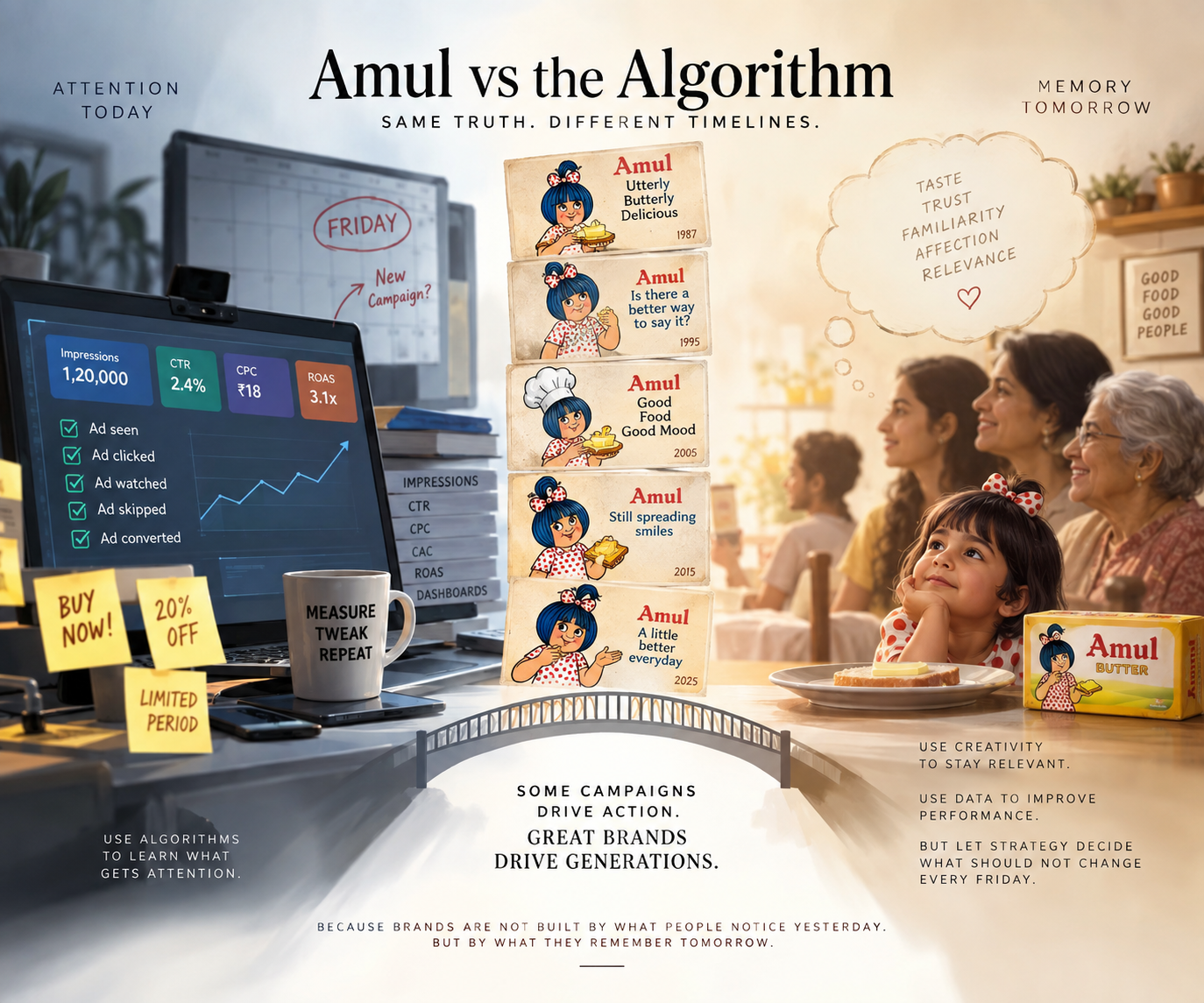
Perhaps the biggest casualty of measurable marketing is everything valuable that takes time to measure.
We now know how many people saw an ad, clicked it, watched it, skipped it, bought after it and probably what they had for breakfast before doing all of that.
Impressions. CTR. CPC. CAC. ROAS.
We have dashboards measuring dashboards.
And somewhere along the way, because technology made measurement instant, we started expecting marketing to become instant too.
That is where branding gets into trouble.
Performance marketing asks, “What happened after this advertisement?”
Branding asks, “What happens after years of seeing this brand?”
Imagine someone seeing an Amul topical in 1987, enjoying the joke and immediately rushing to the store saying, “I must increase my butter consumption!”
That was never the point.
Each topical made a tiny deposit into the consumer’s mind – recognition, familiarity, affection, relevance and trust. One topical probably sold very little butter. Decades of them helped make Amul almost impossible to forget.
That is the mathematics of branding. It compounds before it converts.
Yet, we often evaluate brand campaigns with sales-campaign mathematics.
“We spent ?10 lakh. How much revenue did this campaign generate?”
Fair question. Wrong spreadsheet.
Some communication is designed to make people act now; some is designed to make sure they think of you when they are ready to act.
Confuse the two and eventually every piece of communication starts shouting:
BUY NOW. 20% OFF. LIMITED PERIOD. CLICK HERE.
The brand becomes a salesman permanently standing outside the shop with a megaphone. Useful for today’s sale. Exhausting as a long-term relationship.
This does not mean branding should escape accountability under the convenient excuse that “brands take time.”
Data matters. But perhaps we need to measure the right data over the right period.
Are more people recognising you without seeing your logo?
Are they searching for you by name? Talking about you? Choosing you when a cheaper option exists? Recommending you? Remembering you when the category comes up?
These are not soft outcomes. They are slow outcomes.
And that, perhaps, is the biggest lesson from Amul:
Use algorithms to learn what gets attention.
Use creativity to stay relevant.
Use data to improve performance.
But let strategy decide what should not change every Friday.
Because algorithms can tell us what people noticed yesterday.
Brands are built by what people remember tomorrow.
So perhaps the questions are not merely:
Did this campaign perform? What was the ROAS?
Perhaps we should also ask:
Are we building memory or merely buying attention?
Are we creating a brand that performs this Friday, or one people will still remember years from now?