
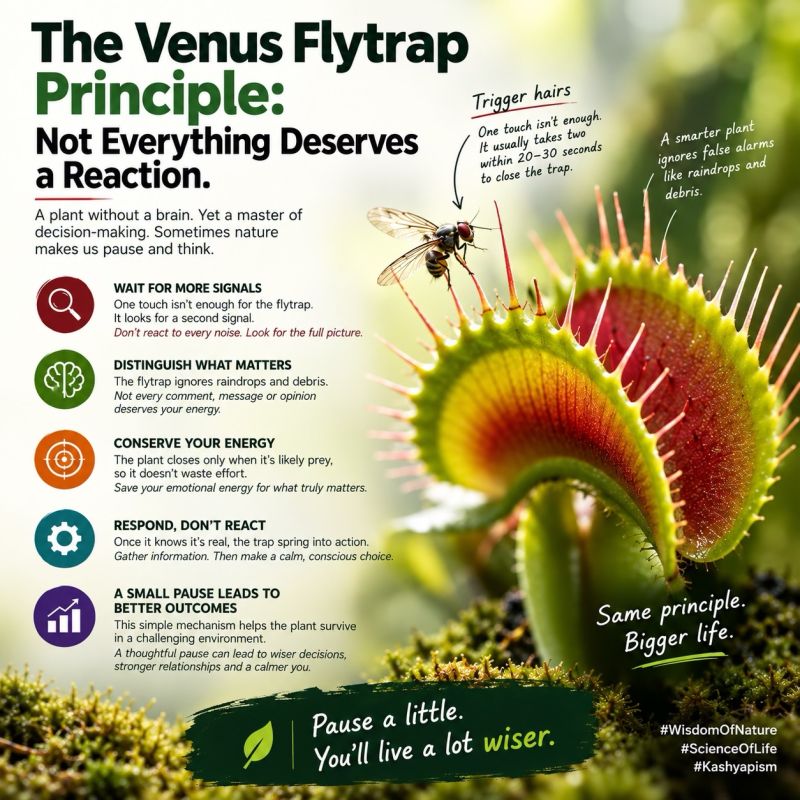
Perhaps one of life’s most useful lessons comes from a plant that survives by knowing when NOT to react.
The Venus flytrap is famous for snapping shut when an unsuspecting insect wanders in.
But here’s the fascinating part.
Inside each trap are tiny, sensitive trigger hairs. One touch usually isn’t enough to close it. Typically, the plant waits for another touch within roughly 20-30 seconds before snapping shut.
Why?
Because closing the trap costs energy.
A raindrop could touch it.
A falling leaf could.
Some random debris could.
If the plant reacted to everything that touched it, it would spend its life snapping at nothing.
Nature, apparently, discovered emotional intelligence before we discovered emotions.
Humans, unfortunately, haven’t always caught up.
Someone doesn’t reply to a message.
Something must be wrong.
Someone makes an unpleasant comment.
Let’s react immediately.
Someone disagrees with us.
Let’s prepare a 14-point defence.
A friend behaves differently one day or a colleague sounds unusually cold, and our internal flytrap goes SNAP!
We react first and understand later.
Sometimes much later.
The Venus flytrap offers a surprisingly useful alternative:
Wait for the second signal.
Not literally, of course.
But before reacting, gather more information.
– Was that comment really intended the way you interpreted it?
– Could there be something happening in the other person’s life that you don’t know?
– Is this a pattern or merely an incident?
– Is it even important enough to deserve your energy?
That small pause between trigger and response can save us from surprisingly large misunderstandings.
This doesn’t mean ignoring things that matter.
The Venus flytrap doesn’t remain permanently open either.
When sufficient signals arrive, it acts.
Perhaps that is the real lesson.
Don’t become less sensitive.
Become more discerning.
Know what deserves a conversation and what deserves silence.
What needs clarification and what needs to be ignored.
What is a genuine signal and what is simply noise.
Because maturity isn’t reaching a stage where nothing triggers you.
It is reaching a stage where not everything gets access to your reaction.
Relationships become easier when every misunderstanding doesn’t become an argument.
Leadership becomes better when every disagreement isn’t treated as defiance.
Life becomes lighter when every opinion doesn’t require a response.
We spend considerable time learning how to respond.
Perhaps nature is quietly teaching us something even more valuable:
Learn when to respond.
So the next time something triggers you, borrow a little wisdom from a plant without a brain.
Before you snap shut, ask:
– Do I know enough, or am I merely assuming enough?
– Is this worth my energy?
And perhaps the most important one:
– Does this really require my reaction… or just my pause?